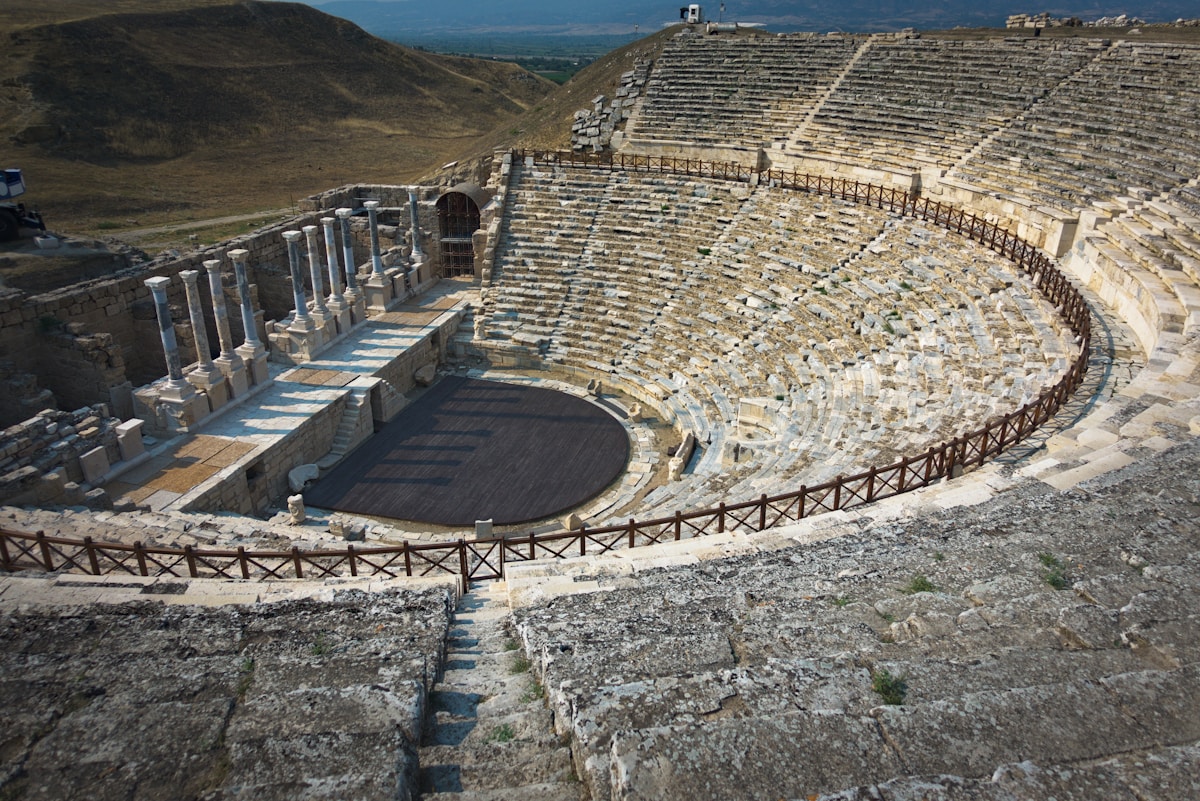
Ankara’s history is in some ways the hidden history of Turkey - the Anatolian interior was less visited by travellers, less documented by European historians, and less excavated than the spectacular coastal sites of Ephesus, Pergamon, or Troy. But the Ankara region was inhabited continuously for millennia and was, at different points, the capital of the Galatian kingdom, a significant Roman provincial city, and - most importantly - the operational base from which Mustafa Kemal Atatürk directed the War of Independence and built the Turkish Republic.
Bronze Age and Hittite period
The Ankara plateau was inhabited in the Bronze Age - the surrounding region contains significant Hittite and pre-Hittite archaeological sites.
Alacahöyük: 150km north of Ankara, one of the most important Bronze Age sites in Anatolia - the royal tombs (c. 2400–2200 BCE) discovered here contained the gold objects and bronze standards now in the Museum of Anatolian Civilisations. These tombs predate the Hittite Empire and show the existence of sophisticated political and religious culture on the Anatolian plateau before the Hittite period.
Hittite period (c. 1600–1200 BCE): The Hittite Empire, centred at Hattuşa (Boğazköy, 200km northeast of Ankara), controlled the Anatolian plateau during the Late Bronze Age. The Ankara region was within the Hittite sphere; the Museum of Anatolian Civilisations houses the most comprehensive collection of Hittite material outside of the Hattuşa site museum.
After the Hittites: The Bronze Age collapse around 1200 BCE disrupted the Hittite Empire and the Mycenaean Greek world simultaneously. The subsequent centuries produced the Neo-Hittite kingdoms of southern Anatolia and the Phrygian kingdom in the plateau - the kingdom of the historical Midas.
Phrygian and pre-Galatian period
Gordion (80km west of Ankara): The Phrygian capital - the city of Gordios and Midas - was located on the Sakarya River southwest of modern Ankara. The Great Tumulus at Gordion (c. 740 BCE) is the largest surviving Phrygian monument. The Phrygians controlled central Anatolia from the 12th century BCE until the Cimmerian invasion of 695 BCE, which effectively ended Phrygian political power.
Persian and Macedonian periods: After the Phrygians, central Anatolia passed to the Lydian kingdom, then to the Achaemenid Persian Empire after Cyrus’s conquest (547 BCE). Alexander the Great crossed Anatolia in 334 BCE - the famous Gordian Knot legend is set at Gordion.
Ancyra - Galatian and Roman capital
The site of modern Ankara - then called Ancyra - became significant with the arrival of the Galatians.
The Galatians: Celtic tribes who migrated from Thrace into central Anatolia in 278–277 BCE, invited by the Bithynian king Nicomedes I as mercenaries and then settling permanently in the central plateau. The Galatians maintained their Celtic language (Galatian, a Continental Celtic language) for several centuries alongside Greek.
Ancyra as Galatian capital: Ancyra became the primary city of the Galatian territory - a position it maintained through the Roman period.
Roman province: Galatia became a Roman client kingdom under the Galatian king Amyntas, and a formal Roman province after his death in 25 BCE. Ancyra was the provincial capital.
Augustus’s inscription - the Res Gestae: The most significant historical artefact in Ankara is the inscription on the Temple of Augustus - the Res Gestae Divi Augusti, or “Deeds of the Divine Augustus.” Before his death, Emperor Augustus composed a summary of his reign - military victories, financial distributions, buildings constructed, games organised - and ordered it inscribed on bronze tablets in Rome and on stone at provincial temples across the empire. The Ancyra inscription (in Latin with Greek translation) is the only substantially complete surviving copy. It was discovered by Ogier Ghiselin de Busbecq, the Habsburg ambassador to the Ottoman Empire, in 1555 - one of the most significant documentary discoveries of the Renaissance.
Roman Ancyra: The city grew significantly under Roman rule - baths, temples, colonnaded streets, the agora. The Temple of Augustus itself dates to the late 1st century BCE / early 1st century CE, built to commemorate the deification of the first emperor.
Byzantine Ancyra (Ankara)
Early Byzantine: Ancyra continued as a significant city in the eastern Roman (Byzantine) Empire - a bishopric from the early Christian centuries, site of the Council of Ancyra (314 CE, one of the early councils defining Christian doctrine on questions of conduct and penance).
Arab raids: The 7th–9th century Arab expansion brought repeated raids against Byzantine Anatolia. Ancyra was taken by Arab forces multiple times; the Byzantine response was to fortify the citadel hill - the Ankara Kalesi (Citadel) dates in its original Byzantine form to this period.
Seljuk and Mongol periods: Anatolia’s political fragmentation after the Battle of Manzikert (1071) eventually brought Ankara under Seljuk Sultanate of Rum control. The city passed between various powers - a Danishmend emirate period, Mongol suzerainty after the Battle of Köse Dağ (1243) - before becoming Ottoman territory.
Ottoman Ankara
Ottoman incorporation: Ankara came under Ottoman control in the late 14th century - Murad I claimed the region, and Ankara was definitively Ottoman after Mehmed I’s restoration of Ottoman power following Timur’s defeat of Bayezid I at the Battle of Ankara (1402).
The Battle of Ankara (1402): One of the most significant battles in Ottoman history - Timur (Tamerlane) defeated and captured Sultan Bayezid I on the plain east of Ankara. The defeat temporarily fragmented the Ottoman Empire and is unusual in that the battle was fought on what is now the outskirts of the modern city.
Ottoman Ankara: A provincial commercial centre - significant for its Angora goat wool (the origin of “mohair” from “Ankara,” through the French corruption) and its position on the road between Istanbul and the eastern provinces. Not a major imperial city; not neglected.
Population: Ottoman Ankara had a mixed Muslim and Greek Orthodox (Rum) population, along with Armenian and Jewish communities. The Greek community was significant in the commercial life of the city.
The War of Independence and the founding of the capital (1919–1923)
The decision that transformed Ankara from a provincial Anatolian town to a capital city was made in 1919–1920 under circumstances of acute crisis.
The context: The Ottoman defeat in World War I led to the Treaty of Sèvres (1920), which proposed to partition Anatolia between Greece, Armenia, France, Italy, and a rump Turkish state. Greek forces landed at İzmir in May 1919 and began advancing into western Anatolia.
Mustafa Kemal at Ankara: Mustafa Kemal (later Atatürk), a general who had distinguished himself at Gallipoli, arrived in Anatolia in May 1919 with orders to demobilise remaining Ottoman forces. Instead, he organised a resistance movement and convened the Grand National Assembly in Ankara on 23 April 1920 - the founding date of the Turkish Republic.
Why Ankara: The choice was strategic - Ankara was far enough from the coast to be safe from Allied naval power, connected by rail to eastern Anatolia, and central enough to coordinate resistance across the country. The city had approximately 30,000 inhabitants at the time.
The War of Independence (1919–1922): The Turkish nationalist forces, directed from Ankara, defeated the Greek army (the Great Offensive of August 1922), expelled Allied forces from Anatolia, and negotiated the Treaty of Lausanne (1923), which replaced Sèvres and established the borders of modern Turkey.
The Republic and the capital declaration: The Turkish Republic was proclaimed on 29 October 1923. Ankara was declared the capital - a deliberate statement that the new state was Anatolian rather than Ottoman, oriented toward the interior rather than the cosmopolitan Bosphorus.
Building the modern capital (1923–1950s)
The Republican government faced the challenge of building a functional capital from a small provincial town. The process was directed, systematic, and architecturally self-conscious.
Urban planning: The German urban planner Hermann Jansen won the 1928 competition to design a master plan for the new capital. The plan separated government, residential, and commercial zones; created wide boulevards; and established the spatial structure of the city that still defines Ankara’s layout.
Republican architecture: The government commissioned public buildings that expressed the new Republic’s identity - a synthesis of Ottoman, Anatolian, and international modernist influences. The Faculty of Languages, History and Geography (1935–1946), the Central Bank, the National Assembly building - these are the monuments of Republican-era Ankara architecture.
Anıtkabir (1944–1953): The mausoleum of Atatürk, who died in 1938, was designed by architects Emin Onat and Ahmet Orhan Arda after an architectural competition. The structure - incorporating Hittite, Anatolian, and classical elements on a monumental scale - was completed in 1953 and has become the defining monument of modern Turkey.
Historical timeline
| Period | Event |
|---|---|
| c. 2400–2200 BCE | Alacahöyük royal tombs; Bronze Age Anatolian culture |
| c. 1600–1200 BCE | Hittite Empire; Ankara region within Hittite sphere |
| c. 1200 BCE | Bronze Age collapse; Phrygian period begins |
| c. 740 BCE | Gordion (near Ankara) - Great Tumulus built |
| 278–277 BCE | Galatian migration; Ancyra as Galatian city |
| 25 BCE | Galatia becomes Roman province; Ancyra as capital |
| c. 1–25 CE | Temple of Augustus built; Res Gestae inscribed |
| 314 CE | Council of Ancyra |
| 7th–9th c. | Arab raids; Byzantine citadel fortified |
| 1071 | Battle of Manzikert; Seljuk expansion |
| 1402 | Battle of Ankara - Timur defeats Bayezid I |
| 1555 | Res Gestae rediscovered by Habsburg ambassador Busbecq |
| 1919 | Mustafa Kemal arrives in Anatolia; resistance begins |
| 23 April 1920 | Grand National Assembly convened in Ankara |
| 29 October 1923 | Turkish Republic proclaimed; Ankara declared capital |
| 1928 | Jansen master plan for new capital |
| 1938 | Atatürk dies in Istanbul |
| 1944–1953 | Anıtkabir constructed |
- Things to do in Ankara
- Museum of Anatolian Civilisations - detailed visit guide in things to do
- Ankara food guide
Search hotels in Ankara on Booking.com
Exploring the sites: Browse tours and activities in Ankara for guided historical tours of Ankara - expert commentary makes a significant difference at layered archaeological sites.