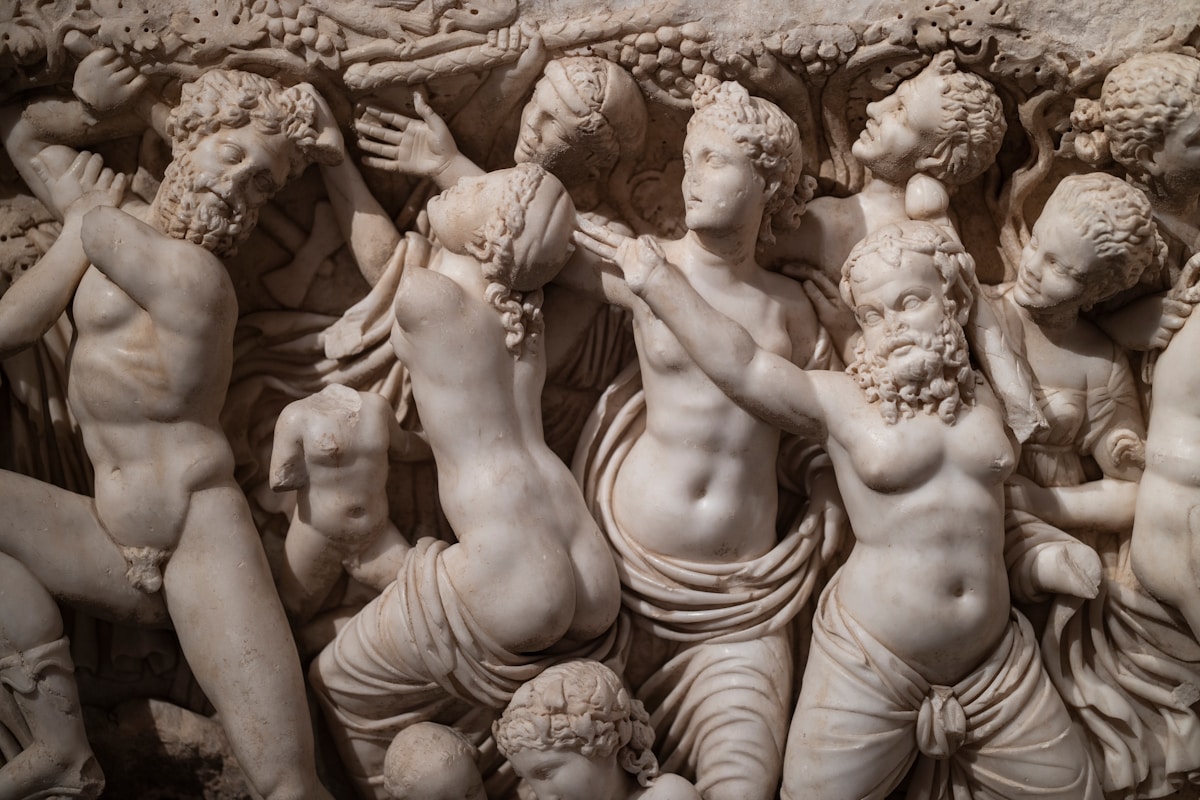
Ankara’s attractions are concentrated and significant - three sites alone (Anıtkabir, the Museum of Anatolian Civilisations, and the Citadel) justify the trip. The city rewards a focused two-day visit rather than a leisurely week: see what matters, see it properly, and move on. This is not a criticism - it simply reflects what Ankara is.
Anıtkabir - Atatürk’s Mausoleum
Location: Anıttepe district, 4km southwest of Kızılay. Metro to Tandoğan, then 20-minute walk or taxi.
Entry: Free. Open daily 09:00–17:00 (winter) and 09:00–17:00 (summer); extended hours on national holidays.
Anıtkabir is the mausoleum of Mustafa Kemal Atatürk - the founder of the Turkish Republic, who died in 1938. The complex was built between 1944 and 1953 to designs by architects Emin Onat and Ahmet Orhan Arda, who drew on Anatolian, Hittite, and classical architectural traditions to produce something that feels genuinely original rather than derivative.
The approach: The Lion Road - a 262-metre ceremonial path flanked by 24 stone lions (Hittite in style) - sets the scale before you reach the main complex. The lions symbolise power and independence; the number refers to the 24 Oğuz tribes of the Turkic peoples.
The courtyard: The main mausoleum sits on a raised platform surrounded by a colonnaded hall. The scale is intentional - this is a structure designed to communicate permanence and the weight of a founding moment. The geometric ornament on the columns and ceilings is meticulously detailed.
The tomb hall: Atatürk’s cenotaph - a 40-tonne monolith of red Turkish marble - occupies the main hall. The actual sarcophagus is in a crypt below. The scale and the silence produce a genuinely affecting atmosphere; the Turkish visitors around you - many weeping, many in military uniform, many having travelled specifically for this visit - add to the weight of the experience regardless of your own political perspective.
The museum: The Atatürk and War of Independence Museum within the complex displays personal effects, documents, photographs, and military artefacts from the 1919–1923 War of Independence and the founding of the Republic. Well documented in English.
Practical: Dress respectfully (no shorts in the mausoleum hall itself - a rule enforced at the entrance). The full visit takes 1.5–2.5 hours. Arrive early on national holidays (23 April, 19 May, 29 October) when the site is extremely crowded.
Museum of Anatolian Civilisations
Location: At the base of the Ankara Citadel, Gözcü district. Walking distance from the Citadel.
Entry: ₺200. Open Tuesday–Sunday 08:30–17:30 (closed Monday).
This is one of the great archaeological museums in the world - not primarily because of the building (though the restored 15th-century Ottoman bedesten and covered bazaar are architecturally beautiful), but because the collection it houses has no equivalent elsewhere.
What makes it irreplaceable: The Museum of Anatolian Civilisations holds the only comprehensive sequential collection of objects from Anatolia’s prehistoric and ancient periods - from the earliest settled agricultural communities to the arrival of the Greek cities on the Aegean coast. This is a civilisation sequence that isn’t duplicated anywhere, because Anatolia is where much of it happened first.
The Neolithic gallery: Objects from Çatalhöyük (c. 7500–5700 BCE) - one of the world’s earliest urban settlements, 250km southeast of Ankara near Konya. Figurines, obsidian tools, bull skulls set into walls, and the mud-brick construction details of the settlement’s architecture. This is the transition from nomadic hunter-gatherer to settled agricultural community, displayed with the actual objects.
The Chalcolithic and Early Bronze Age: Hacılar figurines; Alacahöyük royal tombs (c. 2400–2200 BCE) with extraordinary gold objects, bronze standards, and the bull-figure sun discs that have become symbols of ancient Anatolian art. These objects were buried with Anatolian rulers before the Hittites.
The Hittite gallery: The most complete collection of Hittite objects outside of Hittite site museums - reliefs, statues, cuneiform tablets, ritual vessels, and the iconic sphinx and lion gate figures from Alacahöyük, Boğazköy/Hattuşa, and other Hittite ceremonial centres. The Hittites were the first Anatolian civilisation to leave a written record; the cuneiform tablets here are originals.
The Phrygian gallery: Gordion was the Phrygian capital 80km west of Ankara - this is the civilisation of the historical King Midas. The Phrygian objects (furniture, textiles reconstructed from tomb finds, bronze vessels, fibulae) show a sophisticated court culture from the 9th–7th centuries BCE.
The Urartian gallery: The Urartu kingdom of eastern Anatolia (around Lake Van) produced some of the finest metalwork of the ancient Near East - bronze cauldrons, shields, helmets, and horse-trappings with extraordinary decorative precision. Urartu appears in Assyrian records as a rival empire; it disappears from history in the 6th century BCE.
Duration: 2–3 hours minimum for the main sequence. Allow more if you read everything. The audio guide (available in multiple languages) is worth using in the Hittite and Phrygian sections particularly.
Ankara Citadel (Hisar)
Location: On the hill directly above the Museum of Anatolian Civilisations, 2km northeast of Ulus.
Entry: The outer walls are free to walk and explore. Some viewpoints and specific structures charge ₺50–100.
The Citadel - Ankara Kalesi or Hisar - is the oldest inhabited part of the city: a Byzantine and Seljuk fortification built on a rocky outcrop above the Ankara plain, with Ottoman additions and surviving residential streets that make it the most atmospheric area of the city.
History in the stones: The original Byzantine fortification dates to the 7th century CE, built against Arab raids. The Seljuks reinforced and extended it in the 9th–11th centuries. The outer walls use Roman spoliation - columns, inscriptions, and architectural fragments incorporated into the Byzantine masonry, visible if you look closely.
The inner citadel (İç Kale): The highest point, with the best views across the Ankara plain and the modern city spreading in every direction. The contrast between the ancient stone and the modern capital below gives this viewpoint its particular character.
The residential streets: Parts of the Citadel are still lived in - winding stone streets, traditional timber-framed houses (many restored, some still in their original state of gentle decay), cats on every wall, small tea houses, and artisan workshops. This is the most human-scale and most photographable part of Ankara.
Çıkrıkçılar Yokuşu (Copper Bazaar): The market street running down from the Citadel toward Ulus - antiques, copperware, old household goods, restored Soviet-era cameras, traditional musical instruments, and miscellaneous curiosities. More genuine street market than tourist bazaar; worth an hour of unhurried wandering.
Temple of Augustus (Monumentum Ancyranum)
Location: Ulus district, 1km north of Kızılay. Within walking distance of the Citadel.
Entry: ₺100 (exterior viewable from outside for free).
The Temple of Augustus (the Monumentum Ancyranum) is Ankara’s most significant ancient monument - a 1st-century BCE Roman temple, substantially intact, with a surviving inscription that is one of the most important documents of the Roman Empire.
The Res Gestae: The walls of the temple’s inner chamber and the outer precinct walls carry the Res Gestae Divi Augusti - the official record of Emperor Augustus’s achievements, inscribed in Latin (with Greek translation) by order of the emperor before his death. The Ankara inscription is one of only two surviving copies and the best preserved. This document - listing military campaigns, financial distributions to citizens, temples built, games organised - is a primary source for Augustan Rome.
The structure: The temple itself was converted to a church in the Byzantine period and then incorporated into a mosque - the combination of uses means the structure survived where a purely pagan monument might not have. The interior is not always accessible but the exterior and the inscriptions visible from the entrance are the primary interest.
Kocatepe Mosque
Location: Kavaklıdere district, 3km south of Ulus.
Entry: Free. Open outside prayer times to visitors.
Kocatepe Mosque is Ankara’s largest mosque - a deliberate Republican-era statement building in the Ottoman Neoclassical style, constructed between 1967 and 1987 on a prominent hill visible from much of the city. The scale is impressive: four minarets, a central dome 45 metres in diameter, capacity for 24,000 worshippers.
Below the mosque: a large commercial complex (supermarket, shopping, parking) - an unusual combination that reflects the modernist-religious negotiation of Republican Turkey.
Visitor note: Dress appropriately; women should have head covering available. Entering during prayer times is not appropriate.
Atakule Tower
Location: Çankaya district, 5km south of Ulus.
Entry: Observation deck ₺80. Rotating restaurant at top.
Atakule is Ankara’s landmark observation tower - 125 metres, with a rotating restaurant at the top and panoramic views of the Ankara plain. Useful for orientation on arrival, particularly striking at dusk when the city sprawls in every direction with no visible limit.
Day trip: Gordion (Midas’s Capital)
Distance: 80km southwest of Ankara by car or bus via Polatlı.
Entry: Site ₺100; Gordion Museum ₺80.
Gordion was the capital of the Phrygian kingdom - the civilisation of the historical King Midas, who ruled c. 740–696 BCE. The site includes the Great Tumulus (Büyük Tümülüs) - the burial mound of a Phrygian king, possibly Midas’s father Gordios (or Midas himself; the chronology is debated), dated to c. 740 BCE.
Inside the Great Tumulus: The burial chamber itself is accessible - preserved intact since excavation by Rodney Young (University of Pennsylvania) in 1957. The wooden chamber within the tumulus is the oldest standing wooden structure in the world, constructed from juniper and pine without nails. The burial furniture (a wooden coffin, bronze cauldrons, wooden tables, textiles) is now in Ankara’s Museum of Anatolian Civilisations; what remains in situ is the chamber and its atmosphere.
The mound field: The landscape around Gordion contains over 80 tumuli of various sizes - a Bronze Age and Iron Age cemetery visible from the road, with the Great Tumulus dominant among them. The site is understated and under-visited; for anyone with an interest in pre-classical Anatolian history, it is one of the most significant sites in Turkey.
Getting there: Minibus from Ankara’s AŞTİ bus station to Polatlı (1 hour); taxi from Polatlı to Gordion (20km, ₺150–200 return with waiting time). Or hire a car in Turkey for a direct drive from Ankara.
Activity summary
| Activity | Entry | Time | Notes |
|---|---|---|---|
| Anıtkabir | Free | 1.5–2.5 hrs | Morning preferred; crowded on holidays |
| Museum of Anatolian Civilisations | ₺200 | 2–3 hrs | Tuesday–Sunday; closed Monday |
| Ankara Citadel | Free–₺100 | 1–2 hrs | Combine with museum |
| Çıkrıkçılar Yokuşu | Free | 1 hr | Below Citadel |
| Temple of Augustus | ₺100 | 30–45 min | Ulus district |
| Kocatepe Mosque | Free | 30 min | Outside prayer times |
| Atakule | ₺80 | 30 min | Views; rotating restaurant |
| Gordion day trip | ₺180 | Full day | 80km; car recommended |
Two-day itinerary
Day 1: Anıtkabir (morning, 2 hours) → lunch near Kızılay → Museum of Anatolian Civilisations (afternoon, 2–3 hours) → Ankara Citadel and Çıkrıkçılar Yokuşu (late afternoon).
Day 2: Temple of Augustus (morning) → Ulus neighbourhood and street breakfast → Kocatepe Mosque → Atakule at dusk. Optional: Gordion as a third day trip.
Search hotels in Ankara on Booking.com
Booking in advance: Browse tours and activities in Ankara - guided walks, skip-the-line tickets, and day tours are bookable ahead with free cancellation.