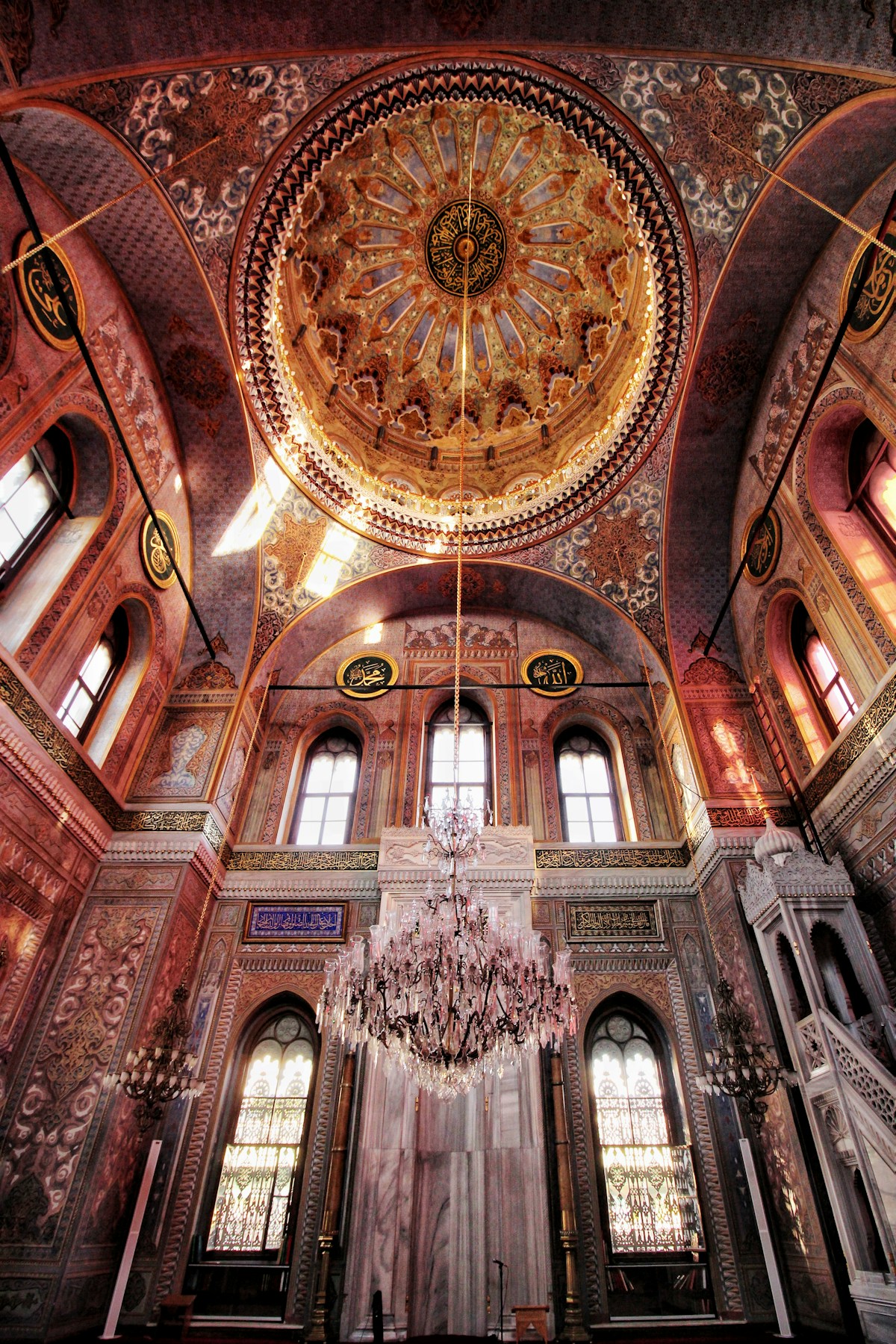
Bursa’s sights cluster in three areas: the Ottoman monuments in the city centre (Ulu Cami, the bazaar district, Koza Han); the Yeşil (Green) district 2km east (Green Mosque, Green Tomb, Bursa Museum of Turkish and Islamic Arts); and Uludağ to the south. A focused two-day visit covers all of them comfortably.
Green Mosque and Green Tomb (Yeşil Cami and Yeşil Türbe)
Location: Yeşil district, 2km east of the city centre.
Entry: Both free. Open daily; mosque closes during prayer times to non-worshippers.
The Green Mosque (1419 CE) is the defining monument of early Ottoman architecture and one of the most beautiful buildings in Turkey. Commissioned by Sultan Mehmed I, it was designed by architect Hacı İvaz Paşa and is named for the tiled interior rather than the exterior (which is marble, not green).
The interior: The tilework is the point - Iznik tiles (produced in nearby İznik, then called Nicaea) in turquoise, green, and dark blue, covering the mihrab and the upper windows with a precision and depth of colour unmatched in any earlier Ottoman building. The geometric and floral patterns on the tiles are technically extraordinary; the mihrab niche in particular is a masterwork of spatial proportion and surface decoration.
The sultan’s loge: The raised platform at the back of the mosque, from which the sultan could observe prayers without being seen - an architectural innovation that reflects the growing distance between Ottoman sovereignty and its subjects. The tiles framing this space are among the finest in the building.
The Green Tomb (Yeşil Türbe): Directly across from the mosque, octagonal, covered in turquoise tiles - the mausoleum of Sultan Mehmed I (died 1421). The tiles were originally bright turquoise-green; the present exterior is a 19th-century restoration. The interior sarcophagus with its polychrome tile decoration is original.
Time required: 1–1.5 hours for both buildings including the approach through the Yeşil neighbourhood.
Grand Mosque (Ulu Cami)
Location: City centre, Atatürk Caddesi. Walking distance from the Koza Han.
Entry: Free.
The Grand Mosque (Ulu Cami, 1396–1399 CE) was built by Sultan Bayezid I following the Battle of Nicopolis (1396) - one of the Ottoman Empire’s most significant early victories over a European crusading force. Bayezid had reportedly vowed to build 20 mosques if victorious; the compromise was one mosque with 20 domes.
The structure: The 20 domes on 12 pillars create an interior forest of columns - a distinctive spatial quality quite different from the single-dome mosques that became dominant in later Ottoman architecture. The scale is significant; the building can accommodate thousands of worshippers.
The calligraphy: The interior walls carry panels of calligraphy by the Ottoman master calligraphers of the late 14th and early 15th centuries - considered some of the finest examples of early Ottoman calligraphic art. The variety of scripts (Kufic, Thuluth, Naskh) is unusually broad for a single building.
The şadırvan (ablution fountain): The interior ablution fountain, open to a skylight dome above, is an unusual feature - interior fountains were later replaced by exterior courtyards in standard Ottoman mosque design. It creates a particularly atmospheric interior when the light changes through the day.
Time required: 30–45 minutes.
Koza Han (Silk Bazaar)
Location: Kapalı Çarşı district, adjacent to Ulu Cami.
Entry: Free.
Koza Han is a 15th-century caravanserai (han) built by Bayezid II in 1491 - the centre of Bursa’s silk trade from the Ottoman period to the present. The han structure (two-storey building with a central courtyard and fountain) remains intact; the shops selling silk goods, cocoons, and silk textiles still occupy the ground-floor cells.
The silk trade: Bursa was the western terminus of the Silk Road from the Ottoman period. Raw silk from China and Central Asia arrived here; Bursa’s own silk industry processed it. The Koza Han’s name means “Cocoon Han” - the courtyard was where silk merchants traded raw cocoons from the surrounding mulberry gardens.
Today: Commercial, but genuinely so - actual silk goods (scarves, cloth by the metre, embroidered textiles) are sold here alongside the tourist market. The craftsmanship of the better silk shops is genuine; prices for hand-loomed Bursa silk are high (₺300–1,500+ for a scarf) but the product is authentic.
The courtyard: Worth sitting in regardless of shopping intent - the 15th-century architecture, the fountain at the centre, and the continued commercial use create one of the most atmospheric spaces in any Turkish city.
Time required: 30–60 minutes for the courtyard and browsing.
Bedesten (Covered Bazaar)
Location: Adjacent to Koza Han.
Entry: Free.
Bursa’s Bedesten - the covered bazaar built within the Koza Han complex - houses jewellers, textile merchants, and antique dealers. Less theatrical than Istanbul’s Grand Bazaar; more genuine in its commercial function.
Inlaid woodwork (ahşap işlemeciliği): Bursa is Turkey’s centre for traditional inlaid woodwork - furniture, mirror frames, and decorative objects with intricate geometric and floral patterns in ebony, boxwood, mother-of-pearl, and bone. Several workshops in the Bedesten and surrounding streets demonstrate the craft. ₺500–5,000+ for quality pieces.
Tophane - Tombs of Osman and Orhan
Location: Tophane district, above the city centre.
Entry: Free.
The tombs of Osman I (the founder of the Ottoman dynasty) and his son Orhan I (who captured Bursa in 1326) occupy a hillside park above the city. The tombs are 19th-century reconstructions - the originals were destroyed in the 1855 earthquake - but the site has genuine historical weight: these are the founding figures of an empire that lasted 600 years.
The view: The Tophane park looks across Bursa’s urban spread to the Bursa plain and the snow-capped Uludağ ridge behind. One of the best viewpoints in the city.
Time required: 30–45 minutes including the walk up.
Bursa Museum of Turkish and Islamic Arts (Türk ve İslam Eserleri Müzesi)
Location: Yeşil district, near Green Mosque.
Entry: ₺100.
Housed in the Green Imaret (theological school, 1419 CE), this museum contains a collection of Ottoman crafts - inlaid woodwork, Iznik ceramics, coins, calligraphy, and household objects from the 14th–17th centuries. Good context for understanding the material culture of early Ottoman Bursa. 1–1.5 hours.
Cumalıkızık Village
Location: 12km east of Bursa city centre.
Access: Minibus from Bursa, 20 minutes.
Cumalıkızık is one of the best-preserved Ottoman village settlements in Turkey - a UNESCO World Heritage Site (as part of the Bursa and Cumalıkızık entry). The village has retained its original street plan and Ottoman timber-framed houses; approximately 270 houses survive from the 14th–16th centuries.
Character: Cobbled streets, houses with overhanging upper floors, old plane trees, a village square. On weekday mornings before the day-trip crowds arrive, the village is genuinely quiet and atmospheric. On weekends it receives significant visitor numbers from Istanbul and Bursa.
Time required: 2–3 hours.
Uludağ - Cable Car and Mountain
Distance: 36km from Bursa city centre by road; accessible by cable car (teleferik) from Teferrüç district.
Cable car: Bursa Teleferik - two stages: Bursa to Sarıalan (1,635m), then Sarıalan to Uludağ summit area (1,875m). ₺200–250 return for both stages. Operates year-round (weather permitting); 30–40 minutes total journey.
Summer Uludağ: Day hiking in the forest and alpine zones; viewpoints across the Bursa plain and Marmara Sea on clear days; cool temperatures when Bursa is hot. Several tea houses and restaurants at the summit area.
Winter Uludağ (December–March): Turkey’s most popular ski resort - 23 lifts, 57 runs, altitude 1,750–2,543m. Heavily used by Istanbul weekenders; peak season (January–February) requires advance hotel booking. Day ski pass: ₺600–1,000.
Time required: Half-day for cable car + summit walk; full day for hiking or skiing.
Bursa thermal baths (Kaplıca)
Bursa sits above significant geothermal activity - the Çekirge district (4km west of centre) has Ottoman-era thermal bath complexes fed by 78°C natural springs.
Eski Kaplıca (Old Bath): Ottoman thermal bath dating to the 1390s (founded by Sultan Murad I), restored multiple times. The architecture is Ottoman hamam style; the water is natural geothermal mineral water. ₺200–400 for a full bath and scrub session.
Yeni Kaplıca (New Bath): Built by Grand Vizier Rüstem Paşa in 1552 - another period thermal complex with the original tilework substantially intact. ₺250–450.
Modern thermal hotels: Several hotels in Çekirge use the same geothermal water in private bath facilities - a more upscale alternative to the public hamams.
Activity summary
| Activity | Entry | Time | Notes |
|---|---|---|---|
| Green Mosque + Tomb | Free | 1–1.5 hrs | Closed during prayers |
| Grand Mosque | Free | 30–45 min | Large interior; calligraphy |
| Koza Han | Free | 30–60 min | Silk shopping; courtyard |
| Tophane tombs | Free | 30 min | Best city viewpoint |
| Turkish & Islamic Arts Museum | ₺100 | 1–1.5 hrs | Yeşil district |
| Cumalıkızık village | Free | 2–3 hrs | 12km east; minibus |
| Uludağ cable car | ₺200–250 | Half day | Year-round |
| Çekirge thermal baths | ₺200–450 | 2–3 hrs | Ottoman hamam |
Search hotels in Bursa on Booking.com
Booking in advance: Browse tours and activities in Bursa - guided walks, skip-the-line tickets, and day tours are bookable ahead with free cancellation.