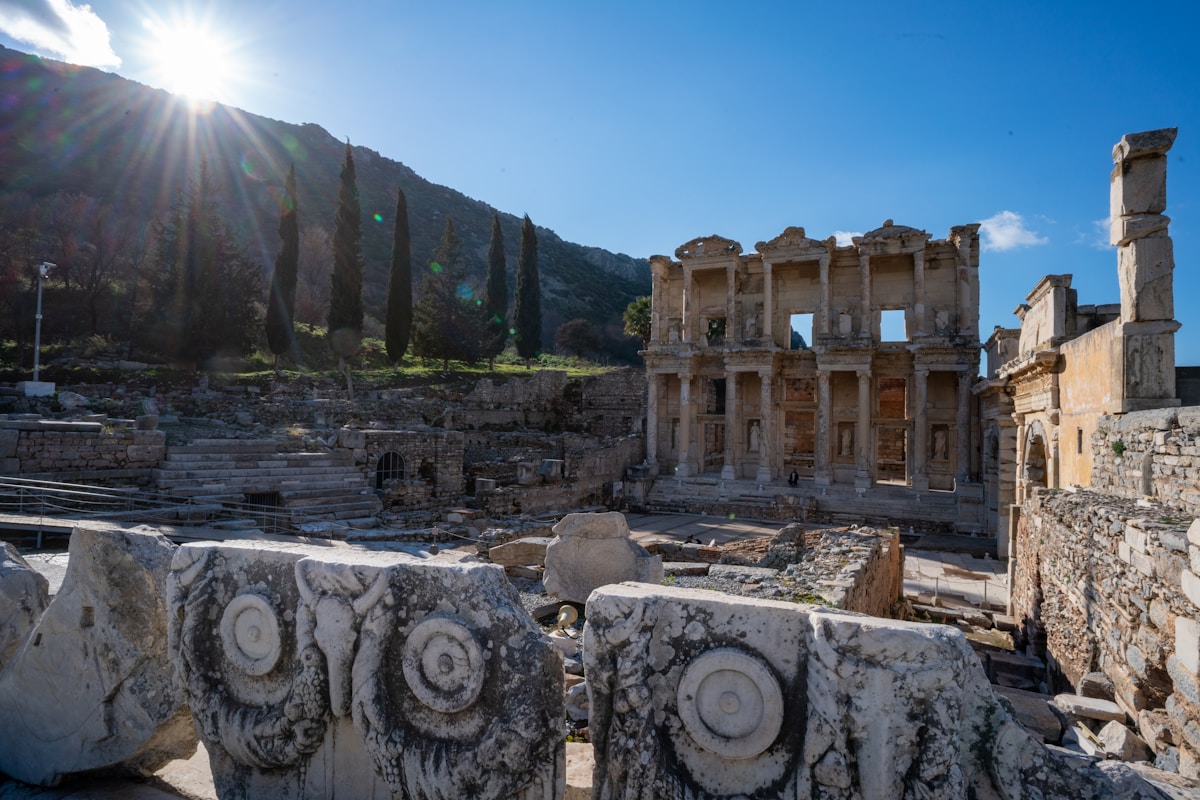
İzmir has one of the longest continuously inhabited urban histories on the Aegean coast - the city of Smyrna was significant in Hellenistic and Roman times, an early Christian community, a major Byzantine port, an Ottoman commercial hub, and a cosmopolitan city of Greeks, Jews, Armenians, and Turks until 1922. The catastrophic fire of September 1922 - which destroyed most of the non-Muslim quarters of the city in the final days of the Greek-Turkish War - is the defining rupture in İzmir’s history. The modern city was built largely after 1922.
Ancient Smyrna
The first settlement at the location of İzmir dates from at least 3,000 BCE, making it one of the oldest continuously inhabited sites in the Aegean region. The Greek colony of Smyrna was established around 1,000 BCE at the head of the İzmir Gulf.
Homer: Several ancient cities claimed Homer as a native son; Smyrna’s claim was among the strongest - the Meles River (now vanished under the city) was associated with him in ancient tradition. The claim is unverifiable, but İzmir has embraced it: the Agora district and the Meles area retain Homeric associations.
Lydia and Persia: Smyrna was destroyed by the Lydian king Alyattes around 600 BCE and remained a village for two centuries. Alexander the Great reportedly had a vision on Mount Pagos (Kadifekale) directing him to refound the city - his general Lysimachos carried out the refounding, building the new Smyrna on the grid plan visible in the ancient Agora.
Hellenistic Smyrna: The refounded city grew rapidly to become one of the most important cities in the Hellenistic world - competing with Ephesus and Pergamon for commercial and cultural supremacy on the Aegean coast. The city declared itself the birthplace of Homer and built a library to house Homeric texts.
Roman Smyrna
Under Roman rule (the province of Asia, from 129 BCE), Smyrna flourished as one of the empire’s most prosperous cities. The Roman infrastructure - the Agora, the theatre on Kadifekale, the harbour works - dates primarily from the 2nd century CE.
The Roman Agora: The Agora that visitors can see today was built after a destructive earthquake in 178 CE - Emperor Marcus Aurelius funded the rebuilding. The western stoa and the underground vaulted galleries are this 2nd-century construction.
Christianity: Smyrna was one of the Seven Churches of Asia mentioned in the Book of Revelation (written c. 95 CE). The letter to Smyrna praises the Christian community there. Polycarp, the Bishop of Smyrna, was martyred here in 155 CE - one of the early church’s most significant martyrdoms.
Prosperity: The Roman Smyrna was known for its wealth, its religious festivals, and its physical beauty - described by ancient geographers as the most beautiful city on the Aegean coast.
Byzantine Period
Smyrna remained under Byzantine control through the early medieval period, continuing as a significant Aegean port and episcopal centre.
Seljuk capture and Byzantine recapture: The city changed hands between Byzantine and Seljuk power several times in the 11th–13th centuries, reflecting the contested character of the western Anatolian coast.
Latin rule and reconquest: During the Crusader period, Smyrna was briefly under various Latin (Western Christian) powers. Byzantine control was restored by the Nicaean Empire and continued until the late Byzantine period.
Genoese fortification: The Genoese - the dominant commercial power in the eastern Mediterranean in the 13th–14th centuries - fortified the castle point (now Kadifekale) as part of their trade network.
Ottoman Smyrna / İzmir
Ottoman conquest (1415): The Ottoman Empire took control of İzmir in 1415 under Mehmed I. The city became an important Ottoman port on the Aegean, increasingly connected to the trade routes of the eastern Mediterranean.
Commercial boom (17th–19th centuries): Ottoman İzmir developed into one of the most important commercial ports in the eastern Mediterranean - a city of some 200,000 people by the 19th century, with substantial Greek Orthodox, Armenian, Sephardic Jewish, and European merchant communities alongside the Turkish Muslim population.
The Franks’ quarter: European merchants established a significant presence in İzmir from the 17th century - the “Frank” (Western European) merchant quarter was among the most prosperous sections of the city. British, French, Dutch, and Venetian merchants traded through İzmir.
Sephardic Jewish community: Ottoman İzmir had one of the largest Sephardic Jewish communities in the Mediterranean world - descendants of the 1492 expulsion from Spain who had settled throughout the Ottoman Empire. İzmir’s Jewish community was one of the wealthiest and most culturally active in the Ottoman world, producing important rabbinical scholars and a distinctive local culture of which boyoz is the most tangible surviving fragment.
The Great Fire of 1922
The catastrophic fire of 13–14 September 1922 destroyed much of İzmir in the final days of the Greek-Turkish War (the Turkish War of Independence). The fire began in the Armenian quarter and spread through the Greek and Armenian sections of the city; the Turkish and Jewish quarters were largely unaffected.
Context: The fire occurred immediately after the Turkish nationalist forces under Mustafa Kemal retook İzmir from Greek forces (Greek occupation of İzmir had begun in 1919 with Allied support). The Greek and Armenian population - a combined majority in the pre-war city - faced violence and the fire in the final days of the war.
Scale: The fire burned for several days. Estimates suggest 10,000–100,000 people died in the fire and the surrounding events; the Greek and Armenian quarters were almost entirely destroyed.
The 1923 population exchange: The formal population exchange under the Lausanne Convention moved the remaining Greek Orthodox community to Greece and settled Muslim refugees from Greece in İzmir. The demographic transformation was total: the cosmopolitan Ottoman city of Greeks, Armenians, Jews, and Turks became a predominantly Turkish Muslim city within two years.
Modern İzmir (1923–present)
The rebuilding of İzmir after 1922 created the modern city structure - wide boulevards, the Kordon promenade, the planned commercial districts. The architecture is largely 1920s–1950s, with later additions.
The Kordon: The Atatürk Bulvarı (Kordon promenade) was developed in the 1920s as İzmir’s signature public space - a statement of the new republic’s vision for its major Aegean city.
Commercial development: İzmir remained a major port and commercial city through the 20th century. The Aegean Fair (now the İzmir International Fair) was established in 1936 and remains one of Turkey’s largest trade exhibitions.
Character today: İzmir has a stronger reputation for secular, liberal, and Western-oriented culture than most Turkish cities - a consequence of its cosmopolitan commercial history and its Aegean geographic position. The city votes consistently for opposition parties in Turkish elections and has a reputation for civic engagement.
Historical timeline
| Period | Event |
|---|---|
| c. 3000 BCE | First settlement at İzmir location |
| c. 1000 BCE | Greek colony of Smyrna established |
| c. 600 BCE | Destroyed by Lydian king Alyattes |
| c. 320 BCE | Refounded by Lysimachos on Kadifekale grid |
| 129 BCE | Roman province of Asia; Smyrna flourishes |
| 178 CE | Earthquake; Roman Agora rebuilt |
| 1415 | Ottoman conquest |
| 1492 | Sephardic Jews arrive after Spanish expulsion |
| 17th–19th c. | Peak commercial era; cosmopolitan port city |
| 1919 | Greek occupation begins |
| September 1922 | Great Fire; Greek and Armenian quarters destroyed |
| 1923 | Population exchange; modern Turkish İzmir begins |
| 1936 | Aegean/İzmir International Fair established |
For the ancient site in the modern city, see things to do in İzmir.
Search hotels in Izmir on Booking.com
Exploring the sites: Browse tours and activities in İzmir for guided historical tours of İzmir - expert commentary makes a significant difference at layered archaeological sites.