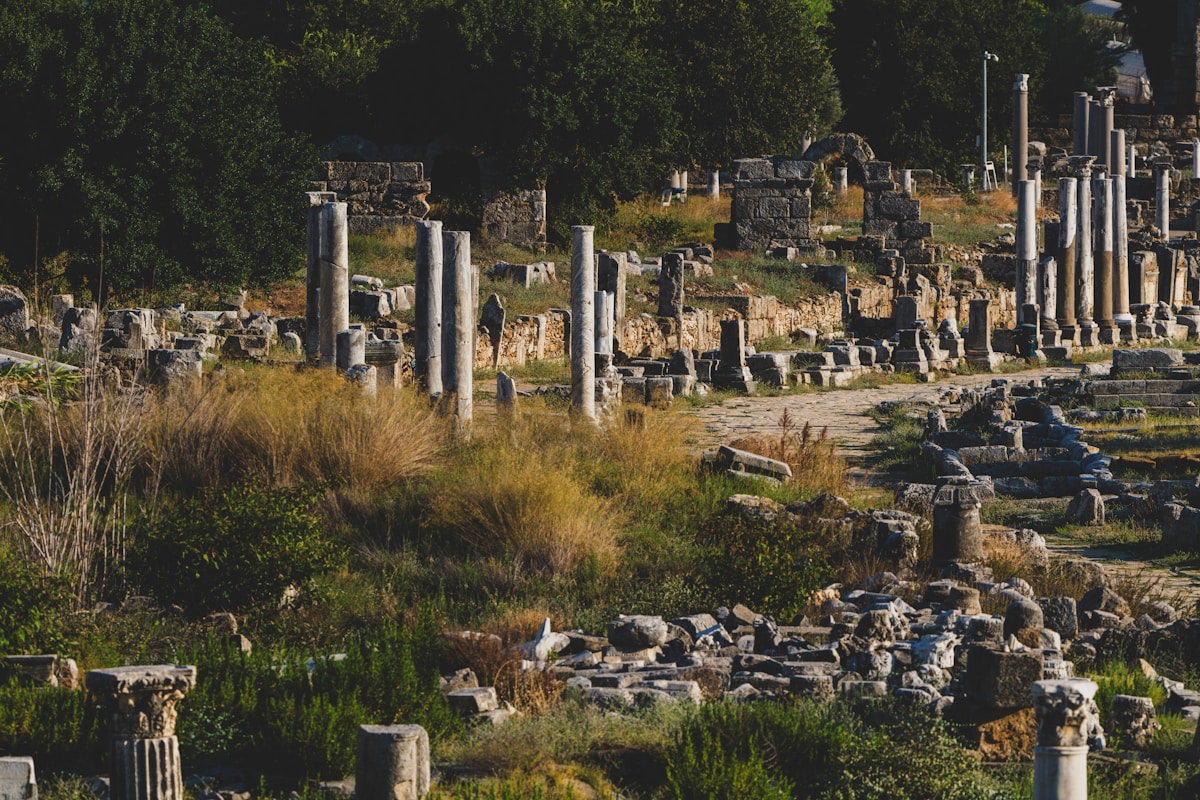
Alanya’s history is inseparable from its peninsula - a 250-metre rocky promontory jutting into the Mediterranean that has been fortified and contested since at least the 4th century BCE. The peninsula’s defensibility attracted Hellenistic princes, Mediterranean pirates, Roman generals, Byzantine administrators, and Seljuk sultans in succession. The castle that stands today - 6.5km of Seljuk walls completed in 1226 CE - is the physical inheritance of this long defensive history.
The modern resort developed in the late 20th century on top of a town that had been, successively, a pirate stronghold, a Seljuk winter capital, an Ottoman provincial harbour, and a small Turkish fishing town. Each layer has left something: the castle, the Red Tower, the bazaar pattern, and the harbour.
Ancient Coracesium
The ancient settlement on the Alanya peninsula was known as Coracesium - a Greek-named coastal town that appears in historical sources from at least the 4th century BCE. The natural geography of the peninsula - steep cliffs on three sides, a narrow land connection on the north - made it an obvious fortification site.
Hellenistic period: Coracesium was a secondary port on the Rough Cilicia coast - the rugged stretch of eastern Mediterranean coastline between Pamphylia (the Antalya region) and Cilicia proper (modern Mersin and Adana). The coast was known for its difficulty and its piracy.
Pirate base: Coracesium became one of the main bases for the Cilician pirates - the most powerful pirate confederation in the ancient Mediterranean - during the 2nd and 1st centuries BCE. The pirates used the fortified peninsula as a stronghold, launching raids across the Mediterranean trade routes and even attacking the Italian coast.
Pompey and the pirates (67 BCE): The Roman Senate commissioned Pompey the Great to eliminate Cilician piracy in 67 BCE. Pompey’s campaign was rapid and comprehensive - he cleared the Mediterranean of piracy in a three-month campaign. The decisive battle was fought at Coracesium: Pompey defeated the main pirate fleet at the base of the peninsula, ending the pirate republic. The pirates surrendered to Pompey; many were resettled rather than executed, in a notably moderate policy for the period.
This naval battle at Coracesium was one of the defining events in Pompey’s career and in Roman Mediterranean history - after it, the sea routes were open for Roman commercial expansion.
Hellenistic and Roman Coracesium
After Pompey’s campaign, Coracesium became a minor provincial town in the Roman province of Cilicia. The defensible peninsula continued to attract fortification - successive layers of walls are visible in the current castle structure.
Roman prosperity: The Pax Romana brought commercial development to the eastern Mediterranean coast. Coracesium participated in the regional trade network, exporting timber from the Taurus mountains and the agricultural produce of the coastal plain.
Cedar and shipbuilding: The Taurus mountains above Alanya were heavily forested with cedar - one of the prized shipbuilding timbers of the ancient world. The Alanya coast was a significant source of timber for Mediterranean shipbuilding from the ancient period through the medieval era.
Byzantine Period
Coracesium remained a Byzantine possession through the centuries of Byzantine rule over the Anatolian coast. The strategic peninsula continued to be fortified, though the town declined in relative importance as the regional urban hierarchy shifted.
Arab raids: The Arab naval campaigns of the 7th–10th centuries periodically threatened the eastern Mediterranean coast. The Alanya peninsula’s fortifications were reinforced during this period.
Later Byzantine weakness: As Byzantine power contracted in Anatolia from the 11th century following the Seljuk victory at Manzikert (1071 CE), the eastern Mediterranean coast became contested. Coracesium/Alanya passed through several hands - Armenian rulers of Cilicia, local Byzantine governors, and eventually Seljuk control.
Alaeddin Keykubad and the Seljuk Winter Capital (1220–1237 CE)
The transformation of Alanya from a contested Byzantine possession to a significant Seljuk capital occurred under Sultan Alaeddin Keykubad I (r. 1220–1237 CE) - the greatest ruler of the Seljuk Sultanate of Rum and the figure most associated with Alanya’s medieval heritage.
Conquest (1220 CE): Alaeddin Keykubad took the peninsula after a prolonged negotiation and partial siege. The local Byzantine ruler, the tekfur of Kalonoros (the Byzantine name for the town), negotiated terms and surrendered, reportedly after Alaeddin sent his wife’s portrait as a gesture of goodwill and marriage. The sultan renamed the town Alaiye - hence Alanya.
The Seljuk construction programme (1220–1230): Alaeddin Keykubad undertook a comprehensive construction campaign:
- Castle walls (1221–1226): The 6.5km of fortification walls enclosing the peninsula - the most extensive Seljuk military construction on the Mediterranean coast.
- Red Tower (Kızılkule, 1226): The 33-metre octagonal harbour tower designed by Ebu Ali Rehhâl of Aleppo - the most sophisticated defensive tower on the Anatolian coast at the time of construction.
- Tersane (shipyard, 1228): The five-bay Seljuk shipyard cut into the cliff base on the western peninsula - one of the only surviving Seljuk shipyards in the world.
- Inner citadel (İç Kale): The summit fortification with a Byzantine church, cisterns, and palace structures.
Winter capital: Alaeddin Keykubad used Alanya as his winter capital - the climate was significantly warmer than the Anatolian plateau capitals (Konya, Sivas) and the Mediterranean port gave naval access. The Seljuk sultan brought his court to Alanya each winter.
Significance: This construction programme is why Alanya retains the most significant Seljuk military architecture on the Turkish coast. The Red Tower alone is considered one of the masterpieces of 13th-century Islamic military architecture.
Later Seljuk and Beylik Period
After Alaeddin Keykubad’s death in 1237, the Seljuk Sultanate of Rum entered a period of decline - weakened by Mongol invasion and internal fragmentation. Alanya passed through various Anatolian Beylik (principality) hands in the late 13th and 14th centuries.
Karamanoğulları: The Karamanoğlu dynasty controlled much of southern Anatolia including Alanya during periods of the late Seljuk and early Ottoman periods.
Mamluks: The Egyptian Mamluk Sultanate reportedly had a claim on Alanya during this period - reflecting the strategic importance of the Mediterranean coastal town.
Ottoman Period
Ottoman incorporation of Alanya occurred in the 15th century. The town became a provincial harbour in the Ottoman Empire - maintaining the castle (which served as an Ottoman administrative fortress and occasional prison), the shipyard, and the bazaar.
Timber trade: The Ottoman navy used the Taurus cedar from above Alanya in shipbuilding - continuing the ancient timber-export economy.
Population: Ottoman Alanya had a mixed Muslim and Greek Orthodox population through the 18th–19th centuries.
Modern Alanya (20th century)
Population exchange (1923): The Lausanne Convention’s population exchange removed the Greek Orthodox community from Alanya (as from all Aegean and Mediterranean coastal towns) and replaced them with Muslim refugees from Greece. The character of the town changed in a single year.
Small fishing town (1923–1960s): Mid-20th century Alanya was a small provincial harbour - fishing, timber, banana farms. The castle stood largely unexcavated; the Red Tower was a ruin.
Restoration and archaeology: Turkish archaeological and restoration work from the 1950s–70s began the systematic documentation and restoration of the Seljuk structures. The Red Tower was restored and opened as a museum.
Tourism development (1970s–present): The combination of the castle, the two beaches, and the warm Mediterranean climate made Alanya an obvious target for Turkish coastal tourism development. German package tourism began arriving in significant numbers in the 1980s. The hotel strip along Cleopatra Beach developed through the 1990s. Mahmutlar became a significant Russian and Ukrainian residential destination in the 2000s–2010s.
Historical timeline
| Period | Event |
|---|---|
| c. 400 BCE | Ancient Coracesium - Hellenistic coastal town |
| 2nd–1st c. BCE | Cilician pirate stronghold |
| 67 BCE | Pompey defeats pirates at Coracesium; end of Cilician piracy |
| 1220 CE | Alaeddin Keykubad I takes the peninsula from Byzantine ruler |
| 1221–1226 | Seljuk castle walls constructed (6.5km) |
| 1226 | Red Tower completed |
| 1228 | Seljuk Tersane (shipyard) completed |
| 1237 | Alaeddin Keykubad dies; Seljuk decline begins |
| 15th c. | Ottoman incorporation |
| 1923 | Population exchange |
| 1980s | Package tourism begins |
| 2000s | Russian/Ukrainian expat community in Mahmutlar |
For the Seljuk architecture in person, see things to do in Alanya. For Seljuk history in context, see history of Antalya.
Search hotels in Alanya on Booking.com
Exploring the sites: Browse tours and activities in Alanya for guided historical tours of Alanya - expert commentary makes a significant difference at layered archaeological sites.