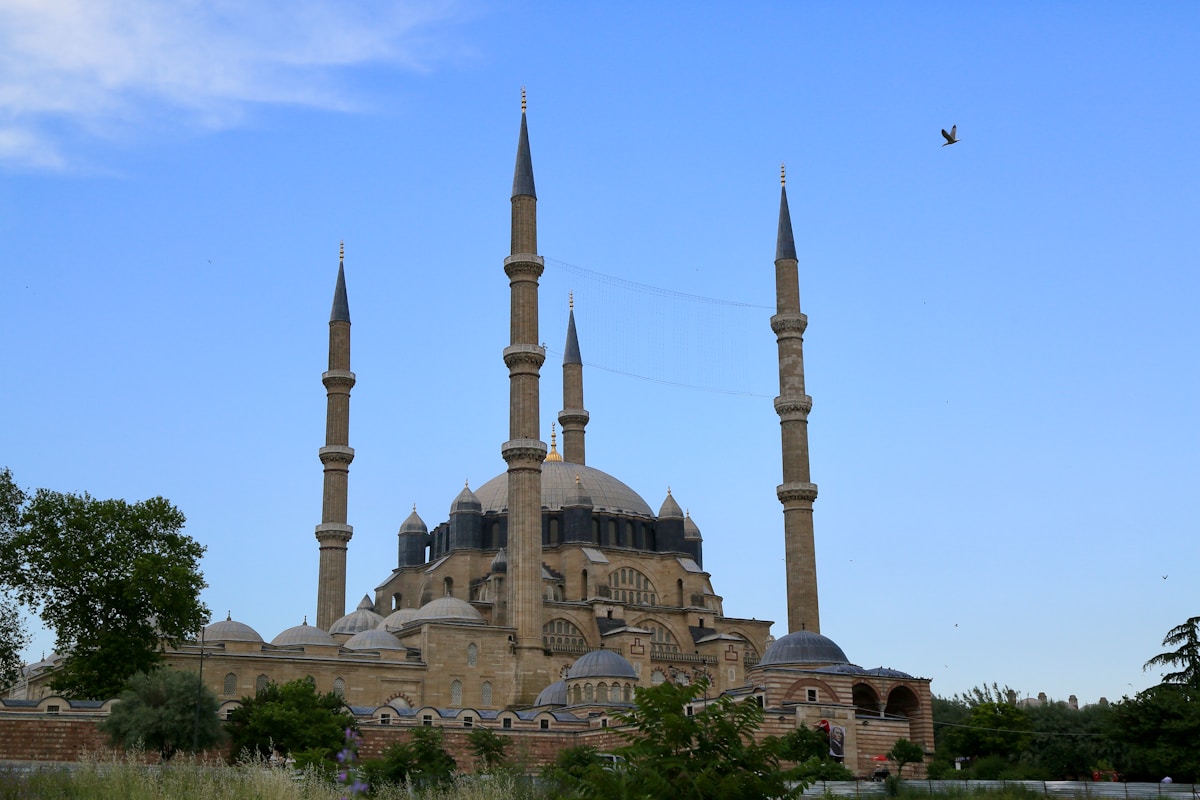
Edirne has been a strategically significant city since antiquity - positioned at the confluence of the Tunca and Meriç rivers on the Thracian plain, it controls the road from the Balkans to Istanbul and the crossing point between Europe and Asia. The city has been fought over, occupied, and rebuilt by Romans, Byzantines, Bulgarians, Crusaders, and Ottomans. Its Ottoman incarnation - as the second capital, the site of the Selimiye, and the origin of the Kırkpınar wrestling tradition - is what defines it today.
Ancient Adrianople
Foundation: The city was founded by the Roman Emperor Hadrian (ruled 117–138 CE) on the site of an earlier Thracian settlement. He named it Hadrianopolis - “Hadrian’s city” - which became Adrianople in its standard English form and eventually Edirne through Byzantine Greek and then Turkish phonetic evolution.
Roman Adrianople: A provincial city in the Roman province of Thrace - important for its position on the Via Militaris (the main military road connecting Constantinople to the Danube frontier) but not a major urban centre in the Roman hierarchy.
Battle of Adrianople (378 CE)
The first Battle of Adrianople (9 August 378 CE) is one of the most consequential battles in the history of the Roman Empire - and arguably in world history.
The context: The Visigoths (Gothic people displaced from their territory north of the Danube by the Hunnic advance) had been allowed to settle inside Roman territory (Moesia, modern Bulgaria) in 376 CE. The Roman administration mishandled the settlement - corrupt officials cheated the Goths of food supplies they had been promised; the Goths revolted.
The battle: Emperor Valens led the Eastern Roman army against the Visigoth force on the plain outside Adrianople. The Visigoth cavalry - heavier and better than Valens had anticipated - destroyed the Roman infantry. Valens himself died in the battle (his body was never found). Two-thirds of the Eastern Roman army was killed.
The consequences: The Battle of Adrianople demonstrated that the Roman army could no longer reliably defeat Germanic forces on open terrain. It accelerated the process of Gothic settlement inside the empire that eventually contributed to the 5th-century dissolution of Western Rome. Gibbon, in The Decline and Fall of the Roman Empire, considered it the beginning of the end of Roman military supremacy.
Byzantine Adrianople (4th–14th centuries)
Under the Byzantine Empire, Adrianople remained a significant city - the second city of Thrace after Constantinople (100km east). Its position on the road from Bulgaria and Serbia to the capital made it militarily critical.
Repeated sieges: Adrianople was besieged and sometimes briefly held by Bulgarian forces (the First Bulgarian Empire was a recurrent Byzantine opponent), Crusader forces (the Latin Empire period, 1204–1261), and various other powers. The city changed hands multiple times but remained predominantly Byzantine through the medieval period.
Fourth Crusade (1204): The sack of Constantinople by the Fourth Crusade created the Latin Empire; Adrianople was contested between the Latin Crusaders and the Bulgarian Empire in the subsequent years. The Battle of Adrianople (1205) - a second famous engagement on the same plains - saw the Bulgarian Tsar Kaloyan defeat and capture the Latin Emperor Baldwin I.
Kırkpınar origin (1346)
The Kırkpınar oil wrestling tradition begins in the Ottoman context before the city even became Ottoman - during a military campaign in 1346, forty Ottoman soldiers (kırkpınar means “forty springs”) held a wrestling competition at this location. According to tradition, two wrestlers were so evenly matched that they wrestled until both died of exhaustion, and were buried at the spring. The tournament has been held in their memory ever since.
The 1346 date makes Kırkpınar one of the oldest continuously documented sporting events in the world.
Ottoman conquest (1361)
Sultan Murad I captured Adrianople in 1361 (some sources give 1363) - this was the first major Ottoman conquest in Europe, representing a fundamental expansion of Ottoman power across the Dardanelles.
The strategic significance: Adrianople controlled the road to Bulgaria, Serbia, and the rest of the Balkans. Its capture meant the Byzantines could be encircled - Constantinople surrounded by Ottoman territory rather than just threatened from the east.
Capital transfer: Shortly after the conquest, Murad I transferred the Ottoman administrative capital from Bursa to Adrianople (Edirne). The capital remained here for ninety years, until Mehmed II conquered Constantinople in 1453.
Edirne as Ottoman capital (1361–1453)
The ninety years of Ottoman rule from Edirne were the period in which the empire expanded across the Balkans, established its administrative structures, and developed the military system (including the Janissary corps) that would define Ottoman power.
Sultan Murad I: From Edirne, Murad I extended Ottoman power into Bulgaria, Macedonia, and Serbia. The Battle of Kosovo Polje (1389) - in which Murad I was assassinated after the Ottoman victory - was a campaign launched from Edirne.
Bayezid I: Continued the Balkan campaigns. The Siege of Constantinople (1394–1402) was directed from Edirne - an attempt to take the Byzantine capital that was ultimately interrupted by Timur’s attack from the east.
Building the capital: The early Ottoman sultans built extensively in Edirne - the Eski Cami (Old Mosque, 1413) and the Üç Şerefeli Cami (Three-Balconied Mosque, 1438–1447) survive. The Edirne Sarayı (palace) was the largest Ottoman palace complex before the Topkapı was built in Istanbul.
Mehmed II and the move to Istanbul (1453)
Mehmed II (Mehmed the Conqueror) launched the final Ottoman siege of Constantinople from Edirne in 1453. The city fell on 29 May 1453; Mehmed immediately designated Istanbul (as Constantinople became known) as the new capital.
Edirne retained its importance as a secondary capital and the last major city before the European frontier - the Ottoman sultans still used the Edirne Sarayı for hunting and military staging - but its role as the primary seat of government ended.
The Selimiye Mosque (1569–1575)
The building that defines Edirne historically and architecturally was completed more than a century after the capital moved.
Sultan Selim II: The commission came from Selim II (reigned 1566–1574). Selim was not one of the Ottoman Empire’s most celebrated sultans - his reign was marked more by administration than military expansion - but his architectural patronage produced the finest building of the entire Ottoman tradition.
Mimar Sinan: The imperial architect Koca Mi’mar Sinan Ağa (c. 1490–1588) was in his late seventies when he began the Selimiye. He had designed over 350 structures including the Süleymaniye Mosque in Istanbul. He considered the Selimiye his masterpiece - the culmination of the structural and spatial experiments he had developed over four decades.
The completion (1575): Sinan solved, in the Selimiye, the structural problem he had been working on since the Üç Şerefeli - how to build a single large dome without the intrusive interior columns that the Hagia Sophia required. By transferring the dome’s load to eight external buttresses, he freed the interior walls for windows, flooding the interior with light.
UNESCO inscription (1993): The Selimiye Mosque complex was inscribed on the UNESCO World Heritage List in 1993 - one of the first Ottoman buildings to receive this recognition.
Later Ottoman and post-Ottoman Edirne
19th century decline: The demolition of the Edirne Sarayı in the 1870s (for building materials for military construction) removed one of the empire’s most significant architectural complexes. The loss is one of the great architectural destructions of the 19th century.
Balkan Wars (1912–1913): Edirne was besieged and captured by Bulgarian forces during the First Balkan War (1912–1913) - the first loss of the city since 1361. It was retaken by Ottoman forces in the Second Balkan War (1913) and retained under the Lausanne Treaty.
Republican Turkey: Edirne remained a border city - significant for its proximity to Greece and Bulgaria, but peripheral to the main currents of Republican Turkish development. The city retains its Ottoman historical character more completely than many Turkish cities because it was not substantially industrialised.
Historical timeline
| Period | Event |
|---|---|
| c. 125 CE | Hadrianopolis founded by Emperor Hadrian |
| 378 CE | Battle of Adrianople - Visigoths defeat Roman army |
| 1205 CE | Second Battle of Adrianople - Bulgarian victory over Latin Empire |
| 1346 | Kırkpınar wrestling tradition begins |
| 1361/1363 | Ottoman conquest; Murad I makes Edirne capital |
| 1389 | Battle of Kosovo Polje; Murad I assassinated |
| 1413 | Eski Cami completed |
| 1438–1447 | Üç Şerefeli Cami built |
| 1453 | Mehmed II conquers Istanbul; capital moves |
| 1484–1488 | Beyazıt II Complex built |
| 1569–1575 | Selimiye Mosque constructed by Mimar Sinan |
| 1870s | Edirne Sarayı demolished |
| 1912–1913 | Bulgarian occupation during Balkan Wars |
| 1913 | Ottoman forces retake Edirne |
| 1993 | Selimiye inscribed UNESCO World Heritage |
Search hotels in Edirne on Booking.com
Exploring the sites: Browse tours and activities in Edirne for guided historical tours of Edirne - expert commentary makes a significant difference at layered archaeological sites.