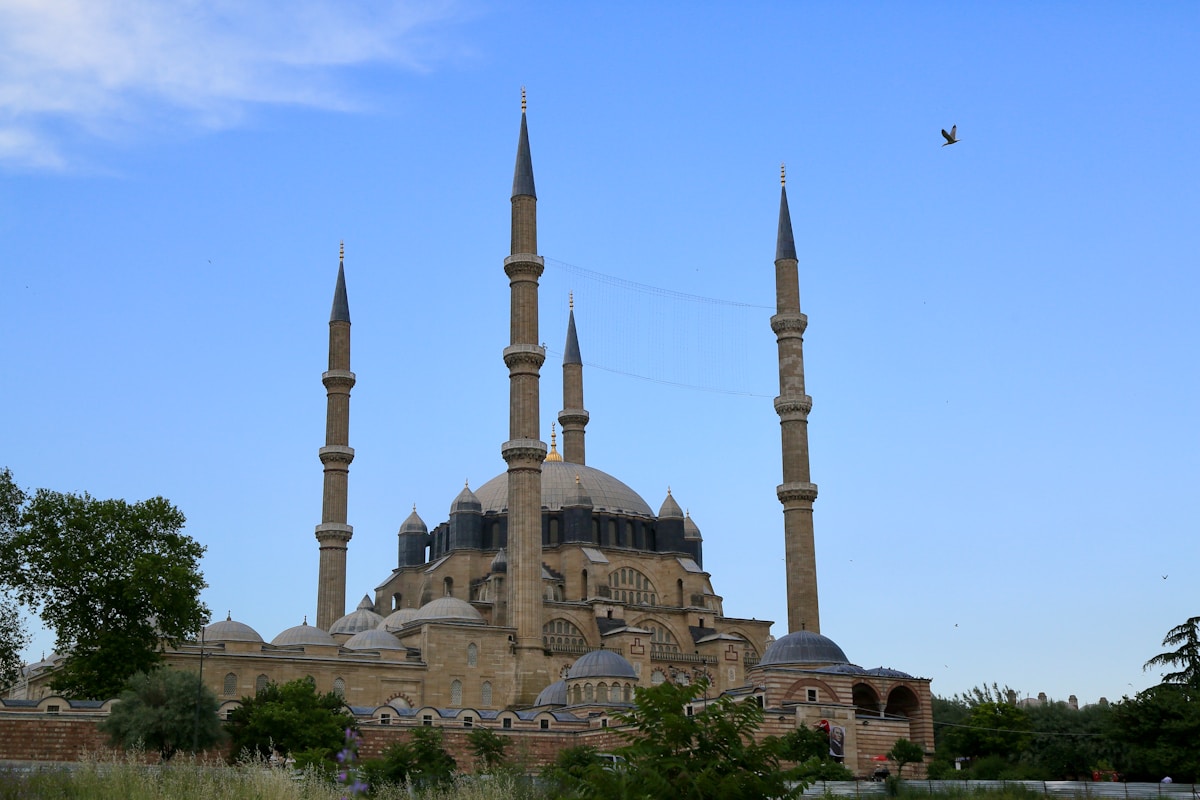
Edirne’s sights are concentrated and can be covered in a focused day or a comfortable two-day visit. The Selimiye alone justifies the journey; the other Ottoman monuments within walking distance make the city a genuine destination for anyone interested in Islamic architecture.
Selimiye Mosque (Selimiye Camii)
Location: On the hill above the city centre, visible from most of Edirne.
Entry: Free (mosque). The adjacent Selimiye Foundation Museum: ₺100.
Open: Daily, outside prayer times. Non-Muslim visitors welcome outside the five daily prayers; the mosque closes briefly to general visitors during prayer.
The Selimiye Mosque is Mimar Sinan’s masterpiece - and by most assessments, one of the supreme buildings of Islamic architecture and of world architecture generally. Sinan himself, who designed over 350 structures including the Süleymaniye Mosque in Istanbul, considered the Selimiye his greatest achievement.
The dome: The central dome is 31.28m in diameter and rises 43.28m from the floor - both dimensions exceed Hagia Sophia’s dome (31m, 55m from floor). The visual impact on entering is the dome’s apparent weightlessness: the structure transfers its load through eight pillars to the exterior, opening the interior of the walls to a gallery of windows that floods the space with light. The effect is of a dome resting on light rather than stone.
The minarets: The four minarets (71m tall) each have three balconies - in Ottoman tradition, the number of balconies indicates the mosque’s precedence: only the most important imperial mosques received multiple-balcony minarets. The four-minaret arrangement frames the dome with a precision that Sinan worked out through multiple designs.
The interior: The calligraphy, tilework (Iznik tiles in the mihrab and sultan’s loge area), carved stone minbar (pulpit), and the overall spatial organisation are all at the highest level of Ottoman craft. The muezzin’s platform (müezzin mahfili) in the centre of the building - supported on twelve columns - is an unusual feature that distributes the sound of the call to prayer through the interior space.
The külliyes: The mosque is surrounded by its külliye (complex of associated buildings) - a medrese (theological school, now the Selimiye Foundation Museum), a school, and a covered market (arasta). The arasta - a row of shops whose rental income supported the mosque’s maintenance - is still in commercial use.
Time required: 1.5–2.5 hours for the mosque, museum, and surrounding complex.
Eski Cami (Old Mosque)
Location: City centre, 5 minutes walk from the Selimiye.
Entry: Free.
The Old Mosque (Eski Cami, completed 1413) is the earliest of Edirne’s great mosques - built during the Ottoman civil war period, completed under Mehmed I. The nine-bay prayer hall with its equal domes and prominent exterior calligraphy makes it one of the finest early Ottoman mosques outside Bursa.
The calligraphy: The exterior walls carry enormous calligraphic inscriptions - Quranic verses and divine names in large-scale Kufic script. The effect is of an exterior surface entirely defined by sacred text.
Interior: Lower, darker, and more intimate than the Selimiye - the early Ottoman multi-dome structure before Sinan developed the single-dome approach. The equal-domed interior has its own specific atmosphere.
Time required: 30–45 minutes.
Üç Şerefeli Cami (Three-Balconied Mosque)
Location: Directly opposite the Eski Cami, adjacent to the Ali Paşa Bazaar.
Entry: Free.
The Three-Balconied Mosque (1438–1447 CE) was a pivotal building in Ottoman architectural history - the first Ottoman mosque to use a single large central dome (24m diameter) supported by two free-standing pillars, a structural solution that Sinan later developed to its logical conclusion in the Selimiye. Building it here in Edirne was the architectural experiment.
The minarets: Four minarets of different heights and different balcony configurations - the tallest has three balconies (üç şerefe - the name of the mosque). Each minaret has a distinctive design; the variety reflects the period of experimentation.
The courtyard: One of the earliest monumental Ottoman mosque courtyards - the model for the later imperial mosque courtyards of Istanbul. The hexagonal fountain at the centre, the colonnaded portico around it, and the proportional relationship between the courtyard and the mosque building were influential.
Time required: 30–45 minutes.
Ali Paşa Covered Bazaar
Location: Between Eski Cami and Üç Şerefeli, city centre.
Entry: Free.
The Ali Paşa Kapalı Çarşı - a 16th-century covered bazaar designed by Mimar Sinan - is still in commercial use. The covered street is shorter and more intimate than Istanbul’s Grand Bazaar; the goods are more local (textiles, household items, some tourist products).
What to buy: Edirne is known for its specific local products - cigeri (liver) preparation, and the specific soap production (Edirne sabunu) that was historically traded along the Balkan road.
Time required: 30–45 minutes.
Edirne Palace (Saray-ı Cedid-i Amire) ruins
Location: On an island in the Tunca River, 2km northwest of the city centre.
Entry: Site is accessible; some areas partially excavated.
The Edirne Sarayı was one of the largest Ottoman palace complexes ever built - extending across the island in the Tunca, with pavilions, gardens, baths, and reception halls. It was the Ottoman sultans’ residence when in Edirne and was substantially destroyed in the 19th century (demolished for its building materials during military construction in the 1870s).
What survives: The Adalet Kasrı (Justice Pavilion, restored), some wall sections, and the Saray Hamam (bath complex). Ongoing archaeological excavation is revealing more of the plan.
Why visit: The scale of what existed here - and the strangeness of its near-total absence in a city that was an imperial capital for ninety years - makes the ruin site thought-provoking rather than visually spectacular. For anyone interested in Ottoman history, the contrast between the survival of the Selimiye and the loss of the palace is striking.
Time required: 1–1.5 hours including the walk to the river island.
Kırkpınar Oil Wrestling
When: Annually in June–July (specific dates vary; usually last week of June to first week of July).
Location: Sarayiçi, the island in the Tunca River where the palace stood - now a sports and events ground.
Kırkpınar (Forty Springs) is the world’s oldest continuously-held sports event with documented history - the first tournament is traced to 1346, when Ottoman forces camped here during a campaign. The format has continued without significant interruption for 675+ years.
The sport: Yağlı güreş (oil wrestling) - competitors (pehlivan) coat themselves in olive oil and wrestle in matches lasting up to 30–40 minutes. The oil removes the ability to grip clothing; wrestlers must control their opponent’s body directly. The heavyweight championship (başpehlivan) match is the event’s culmination.
Scale: Over 1,000 wrestlers compete across all weight categories over three days. The event draws 5,000–15,000 spectators.
UNESCO recognition: Kırkpınar was inscribed on UNESCO’s Representative List of the Intangible Cultural Heritage of Humanity in 2010.
If visiting during the tournament: Book accommodation 2–3 months in advance - Edirne’s hotels fill completely during Kırkpınar week.
Beyazıt II Complex and Health Museum
Location: 1.5km west of the city centre, on the Tunca riverbank.
Entry: Museum: ₺100.
The Beyazıt II complex (1484–1488 CE) includes a mosque, imaret (soup kitchen), medrese, and - most significantly - a darüşşifa (hospital/asylum) that was one of the most advanced medical facilities in the 15th-century world. The hospital used music therapy and water sounds as treatments for mental illness; the concept predated European medical understanding of psychiatric treatment by centuries.
The hospital is now the Edirne Health Museum - a well-presented museum on Ottoman medical practice and the specific therapeutic methods used here.
Time required: 1–1.5 hours.
Muradiye Mosque
Location: 1km west of the Üç Şerefeli, near the Tunca River.
Entry: Free.
A smaller, earlier mosque (1435–1436 CE) built by Murad II - notable for its tilework interior (early Iznik tilework, among the finest surviving examples from this period) and its single-minaret silhouette. Less visited than the city’s major monuments; quieter and more intimate.
Activity summary
| Activity | Entry | Time | Notes |
|---|---|---|---|
| Selimiye Mosque | Free | 1.5–2.5 hrs | UNESCO WHS; close during prayers |
| Selimiye Foundation Museum | ₺100 | 45 min | Adjacent to mosque |
| Eski Cami | Free | 30–45 min | Early Ottoman; calligraphy |
| Üç Şerefeli Mosque | Free | 30–45 min | Pivotal architectural history |
| Ali Paşa Bazaar | Free | 30–45 min | Still commercial |
| Sarayiçi/Palace ruins | Free | 1–1.5 hrs | 2km from centre |
| Beyazıt II Health Museum | ₺100 | 1–1.5 hrs | Ottoman medicine |
| Kırkpınar | Ticket | 3 days | June–July only; book ahead |
Search hotels in Edirne on Booking.com
Booking in advance: Browse tours and activities in Edirne - guided walks, skip-the-line tickets, and day tours are bookable ahead with free cancellation.