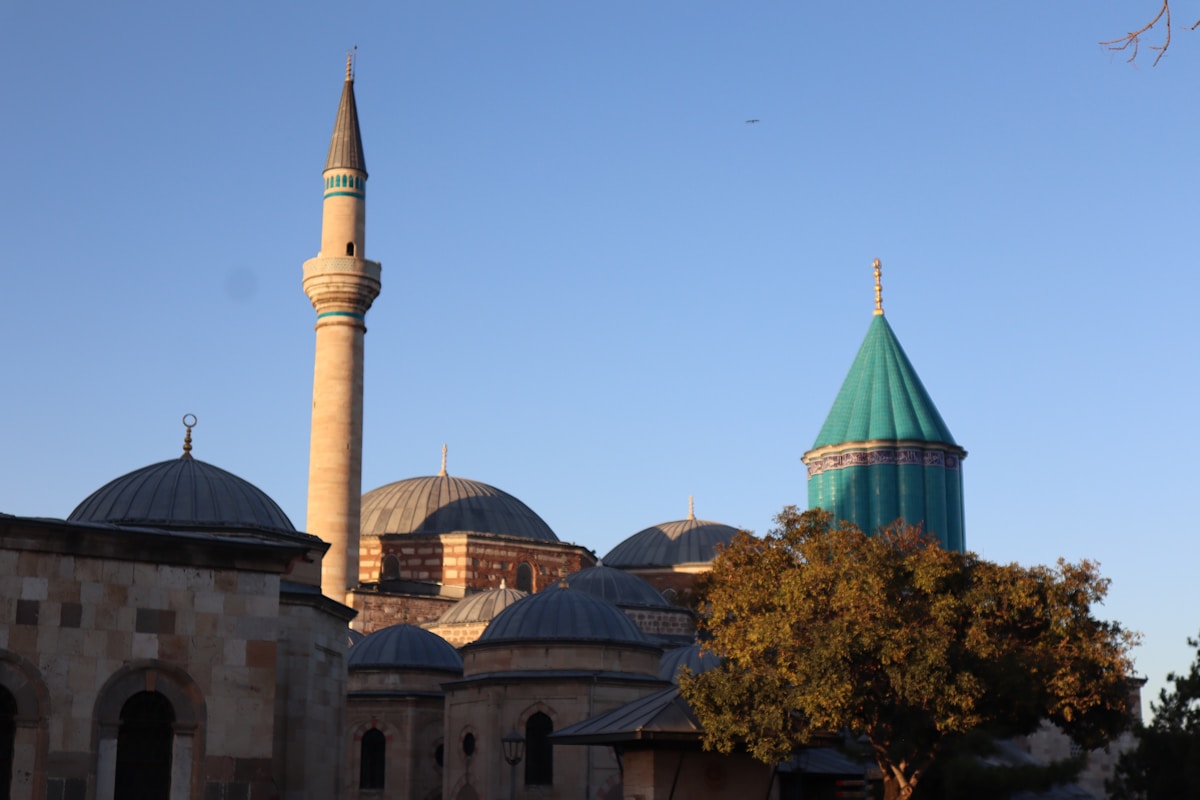
Konya’s history spans the deepest human past - from Çatalhöyük’s Neolithic settlement 9,000 years ago to the Seljuk Sultanate that made it the political capital of Islamic Anatolia, to Rumi’s 13th-century teaching that made it the spiritual centre of the Mevlevi tradition. Few cities combine prehistoric importance with medieval architectural significance and living spiritual heritage in this way.
Çatalhöyük and the Neolithic plain (c. 7500–5700 BCE)
Çatalhöyük - 50km south of modern Konya - is one of the world’s earliest and largest Neolithic settlements. The site was occupied from approximately 7500 to 5700 BCE; at its peak, 8,000 people lived in a dense settlement of mud-brick houses entered through roof hatches.
The significance: Çatalhöyük represents one of the clearest archaeological records of the transition from nomadic hunter-gathering to settled agricultural community - the process by which human civilisation was built. The site has no streets; houses were built directly against each other; movement was across the rooftops.
The wall paintings and ritual: The interiors of Çatalhöyük houses were painted with geometric patterns, hunting scenes, and (most famously) bull heads and auroch skulls mounted in the walls. The dead were buried under the house floors. The evidence suggests a community with sophisticated ritual practice.
Legacy: The objects from Çatalhöyük - the Mother Goddess figurines, the obsidian tools, the cattle skull installations - are in Ankara’s Museum of Anatolian Civilisations. The UNESCO World Heritage Site designation (2012) and ongoing excavation by a British-Turkish team continue to produce findings.
Ancient Iconium
The site of modern Konya was occupied in the Bronze Age and Iron Age - the name Iconium (Greek) appears in ancient sources as a Phrygian and then Lydian and Persian city.
Phrygian period: Iconium was a Phrygian city - part of the same cultural zone as Gordion to the northwest (the Midas civilisation).
Hellenistic and Roman: Alexander the Great passed through Iconium during his Anatolian campaign (334 BCE). The city became part of the Roman province of Galatia.
Saint Paul: The Acts of the Apostles (14:1–7) records Paul and Barnabas preaching in Iconium on Paul’s First Missionary Journey (c. 47–48 CE) - the city had a significant Jewish community. They were eventually driven out by opposition and moved on to Lystra. Iconium is one of the New Testament cities with the clearest historical documentation.
Byzantine Iconium: The city remained part of the Byzantine Empire through the early medieval period - a secondary city in the Anatolian interior, significant as a trading point on the road between the coast and the eastern provinces.
Seljuk conquest and the Sultanate of Rum (1077–1308)
The Seljuks: The Seljuk Turks - a Turkic dynasty from Central Asia, converted to Islam in the 10th century - defeated the Byzantine army at the Battle of Manzikert (1071 CE) and opened Anatolia to Turkic settlement. By 1077, the Sultanate of Rum (Rum = Rome, referring to the Byzantine/Roman territory they had conquered) was established with Konya as its capital.
Why Iconium/Konya: The city’s position on the central Anatolian plain - accessible, defensible, at the intersection of trade routes - made it the natural capital for a power controlling Anatolia.
The Seljuk golden age (12th–13th century): The Sultanate of Rum reached its cultural and political peak under Keykubad I (Alaeddin Keykubad, reigned 1220–1237). The architectural programme of this period produced the buildings that still define Konya’s historical character:
- Alâeddin Mosque (1220–1236): Built by Keykubad I on the hill above Konya - the main Friday mosque of the Sultanate. Marble columns from Roman-era Iconium incorporated.
- Karatay Medrese (1251): Theological school with extraordinary tile dome.
- Ince Minaret Medrese (1265): Stone carving masterwork.
Trade and cultural exchange: The Seljuk Sultanate maintained connections with the wider Islamic world (Persia, Baghdad, Egypt) and with the Byzantine and Crusader states to the west. Konya received scholars, artists, and craftsmen from across the Islamic world - the Iznik tile tradition, Persian architectural influence, and Central Asian ornamental traditions all contributed to the buildings of this period.
Mongol vassalage and decline: The Battle of Köse Dağ (1243) - in which Mongol forces defeated the Seljuk army - made the Sultanate a Mongol vassal state. The subsequent decades saw the effective fragmentation of Seljuk power; the Sultanate formally ended in 1308.
Jalāl al-Dīn Rumi and the Mevlevi order (13th century)
Rumi’s arrival in Konya: Jalāl al-Dīn Muhammad Rumi was born in Balkh (present-day Afghanistan) in 1207, educated in Baghdad and Damascus, and arrived in Konya with his family around 1228, during the reign of Keykubad I. His father, Bahā ud-Dīn Walad, was a respected Sufi scholar; the family was welcomed in Konya.
The transformation: Rumi had been a respected religious scholar and teacher. In 1244, he met Shams-i-Tabrizi - an itinerant Sufi mystic from Tabriz - whose influence transformed Rumi from a scholarly theologian into the ecstatic poet of the Masnavi and Divan. The relationship between Rumi and Shams is the most discussed mystical friendship in the Islamic tradition.
Shams’s disappearance: Shams disappeared in 1248 (the circumstances are disputed; one account holds that Rumi’s son Ala al-Din killed him). Rumi spent years searching for him, then came to understand the encounter as an inner transformation rather than an external relationship.
The Masnavi: Rumi’s major work - 50,000+ couplets of Persian poetry, structured in six books - is one of the most significant works in the Islamic literary tradition. It contains parables, stories, theological arguments, and lyrical passages of extraordinary beauty. The opening image - the reed flute (ney) crying for its separation from the reed bed - is one of the most recognisable images in Sufi literature.
The Mevlevi order: After Rumi’s death in 1273, his son Sultan Walad and then later followers formalised the Mevlevi order - the Sufi brotherhood whose spiritual practice centred on the sema (whirling ceremony). The order spread across the Ottoman Empire; Mevlevi lodges (tekke) were established in Istanbul, Cairo, Damascus, and Sarajevo.
Ottoman Konya
Ottoman incorporation: The Karamanids - the Turkish dynasty that controlled Konya after the Seljuk decline - were absorbed into the Ottoman Empire by Mehmed II in 1466.
The mausoleum development: The Ottomans became significant patrons of the Mevlâna complex - the turquoise-tiled drum over Rumi’s tomb was built by the Karamanids in the 15th century; subsequent Ottoman sultans added to and maintained the complex.
The Mevlevi order in the Ottoman imperial context: The Mevlevi order held a specific status in the Ottoman imperial system - the Ottoman sultans participated in a Mevlevi ceremony at the start of their reigns (the girding of the sword at the Mevlâna complex), and the order maintained lodges across the empire.
Republican Konya
Abolition of the dervish orders (1925): Atatürk’s reforms included the abolition of all Sufi orders (tekke and zawiyas closed) by law in 1925. The Mevlevi order was formally disbanded; the sema ceremony was prohibited as a religious practice.
The museum status: The Mevlâna complex was converted into a museum in 1927 - this status both protected the building and allowed visitation while technically depoliticising the religious practice.
Revival: From 1954, the sema ceremony was permitted as a “cultural performance.” The ambiguity between spiritual practice and cultural performance persists - the official sema in Konya is performed by the Mevlâna Foundation; the religious dimension is understood by participants if not officially acknowledged.
Historical timeline
| Period | Event |
|---|---|
| c. 7500–5700 BCE | Çatalhöyük occupied - Neolithic settlement |
| c. 334 BCE | Alexander the Great passes through Iconium |
| c. 47–48 CE | Paul and Barnabas preach in Iconium |
| 1077 | Seljuk Sultanate of Rum established; Konya as capital |
| 1220–1237 | Reign of Alaeddin Keykubad I; peak Seljuk building programme |
| 1228 | Rumi family arrives in Konya |
| 1244 | Rumi meets Shams-i-Tabrizi |
| 1248 | Shams disappears |
| 1251 | Karatay Medrese completed |
| 1265 | Ince Minaret Medrese completed |
| 1273 | Rumi dies in Konya |
| 1308 | Seljuk Sultanate of Rum ends |
| 1466 | Ottoman conquest; Karamanids absorbed |
| 1925 | Atatürk abolishes Sufi orders |
| 1927 | Mevlâna complex becomes a museum |
| 1954 | Sema permitted as cultural performance |
Search hotels in Konya on Booking.com
Exploring the sites: Browse tours and activities in Konya for guided historical tours of Konya - expert commentary makes a significant difference at layered archaeological sites.