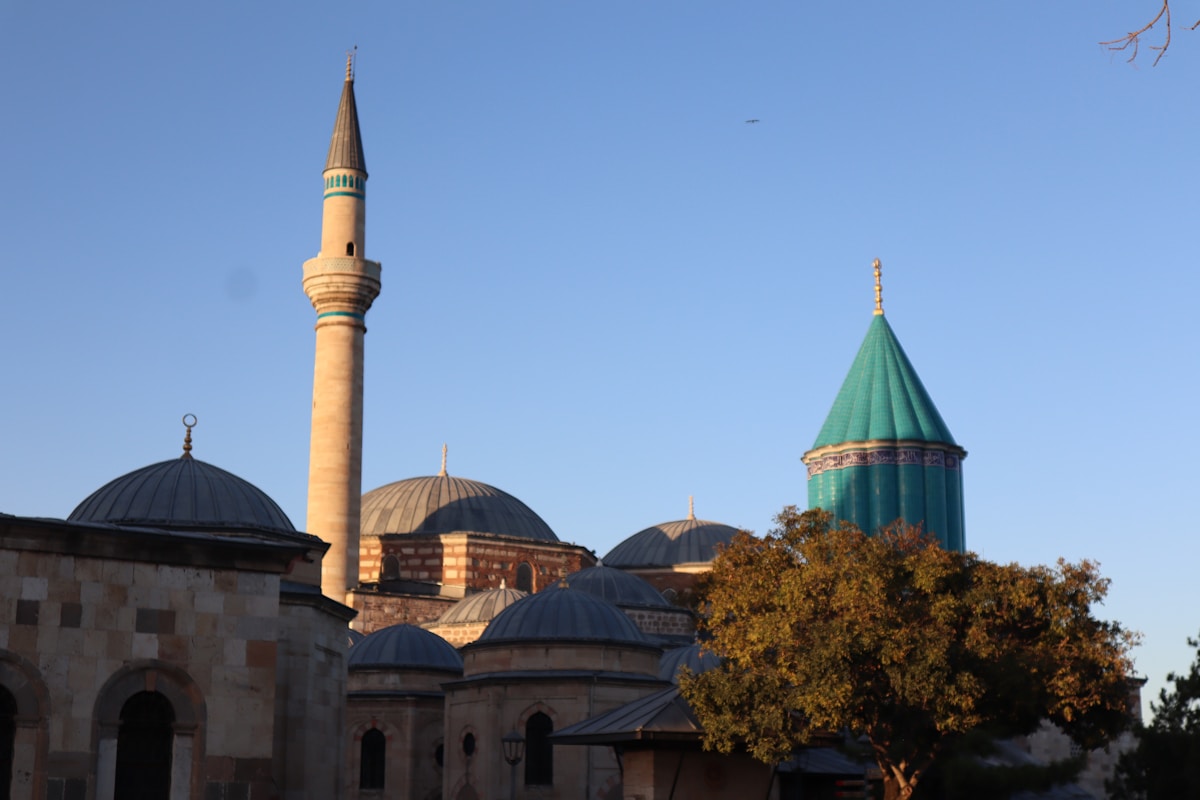
Konya’s sights are concentrated in the historical centre - the Mevlâna complex and the Seljuk-period buildings within walking distance of it cover most of what the city offers architecturally. A focused one-day visit is possible; two days allows Çatalhöyük as a day trip without rushing.
Mevlâna Museum (Mevlâna Müzesi)
Location: City centre, Aziziye district. Walking distance from the main square.
Entry: Free. Open daily 09:00–18:30 (last entry 18:00); extended hours Friday.
The Mevlâna Museum is the complex built around the tomb of Jalāl al-Dīn Rumi - known in Turkey as Mevlânâ (Our Master). It receives 3–4 million visitors annually, making it one of the most visited sites in Turkey.
Who was Rumi: Jalāl al-Dīn Muhammad Rumi (1207–1273 CE) was a 13th-century Sufi mystic, theologian, and poet - born in Balkh (present-day Afghanistan), educated in Baghdad and Damascus, arriving in Konya (then the capital of the Seljuk Sultanate of Rum) around 1228. His major works - the Masnavi (50,000+ couplets, in Persian) and the Divan-i Kabir - are among the most significant literary and spiritual works of the Islamic tradition. His poetry, widely translated into European languages from the 19th century, has made him one of the most-read poets in the English-speaking world.
The mausoleum: The turquoise-tiled cylindrical drum over Rumi’s tomb - the hatched tile pattern is immediately recognisable - was built by the Karamanid dynasty in the 15th century. The complex grew over subsequent centuries; the current museum arrangement dates to the early Republican period.
Interior: The mausoleum hall contains Rumi’s elaborately decorated sarcophagus and the tombs of members of his family and early Mevlevi order. The adjacent semahane (ceremony hall) displays the instruments, robes, and ritual objects of the Mevlevi order. The kitchen section (matbah) shows the daily life of the dervish community.
The crowd: The pilgrimage nature of this site means it is busy every day, extremely busy on weekends and public holidays, and at its most atmospheric at opening time (09:00) before the main crowds arrive.
Photography: Permitted in most areas; respectful conduct required throughout.
Time required: 1.5–2.5 hours.
Sema Ceremony (Whirling Dervishes)
When: The official Konya sema is performed weekly at the Mevlâna Cultural Centre (Mevlâna Kültür Merkezi) near the mausoleum. Check the current schedule on arrival - Wednesday and Saturday evenings are the most common performance days, but schedules change seasonally.
The ceremony: The sema is the Mevlevi order’s practice of remembrance (dhikr) - a 1.5–2 hour ceremony involving musical recitation, Quranic recitation, and the turning of the semazen (whirling dervishes) in white robes and tall felt hats (sikke). The turning is not entertainment but a spiritual practice - the raised right hand receives divine grace; the lowered left hand transmits it to earth.
UNESCO recognition: The sema was inscribed on UNESCO’s Intangible Cultural Heritage list in 2008.
Practical: The official ceremony at the Mevlâna Cultural Centre is free or low-cost and attended primarily by Turkish pilgrims and visitors. Smaller-scale tourist-oriented performances at various venues in the city are also available (₺200–350); the official ceremony is preferable for authenticity.
December Mevlâna commemoration: The main annual festival (Şeb-i Arus - the Wedding Night) on December 17 marks the anniversary of Rumi’s death. The week-long festival (December 10–17) includes official sema ceremonies, concerts, and cultural events. The city is at its most crowded; accommodation books out months in advance.
Karatay Ceramics Museum (Karatay Medrese)
Location: 300m west of the Mevlâna Museum.
Entry: ₺100.
The Karatay Medrese (1251 CE) was built by Jalal al-Din Karatay, a powerful Seljuk emir, as a theological school. The building is now used to display the finest collection of Seljuk and early Ottoman ceramics in Turkey.
The architecture: The portal (taçkapı) - a masterwork of Seljuk stone carving, with the geometric and arabesque ornament characteristic of the tradition - is one of the finest surviving Seljuk architectural details. The dome of the main hall, decorated with turquoise, dark blue, and black tiles, creates an interior of extraordinary visual impact.
The ceramics collection: Iznik tiles, Seljuk-period glazed tiles, and pre-Ottoman Anatolian ceramics. The collection includes the tiles removed from various Seljuk buildings during restoration, displayed with context about their original positions.
Time required: 45–75 minutes.
Ince Minaret Museum (Ince Minaret Medrese)
Location: 200m from the Karatay Medrese.
Entry: ₺100.
The Ince Minaret Medrese (1265 CE) - named for its slender single minaret - houses a museum of Seljuk stone carving and woodcarving. The entrance portal is arguably the finest surviving example of Seljuk stone carving - layers of interlocking geometric ornament of extraordinary precision, with Quranic inscriptions and the central pointed arch rising above.
The collection: Stone reliefs, architectural fragments, and wooden objects from Seljuk buildings across the Konya region. The double-headed eagle motif - a pre-Islamic Anatolian symbol adopted by the Seljuks - appears repeatedly in the stone collection.
The minaret: The original minaret was struck by lightning in the 19th century, truncating it to roughly half its original height. The remaining section still shows the double-row brick decoration.
Time required: 45–60 minutes.
Alâeddin Hill (Alâeddin Tepesi) and Mosque
Location: On the hill above the city centre (Alâeddin Caddesi runs up to it).
Entry: Mosque free.
The Alâeddin Mosque (1220–1236 CE) was the main Friday mosque of the Seljuk Sultanate of Rum - one of the earliest surviving Ottoman-predecessor mosques in Anatolia, built during the reign of Keykubad I.
Architecture: A forest of marble columns (many Roman-era spoliation, taken from earlier Konya buildings), wooden ceiling, and the characteristic Seljuk carved stone mihrab. The building shows the transition between Seljuk and early Ottoman architectural styles.
The hill: The Alâeddin hill was the acropolis of ancient Konya (Iconium). The park on top is one of the best viewpoints over the modern city. The hill also contains the remains of the Seljuk palace (not open but visible from the park paths).
Time required: 45 minutes including the hill approach.
Sahip Ata Complex
Location: 500m south of the Mevlâna Museum.
Entry: Free/₺50 for museum sections.
The Sahip Ata Complex (1258 CE) - mosque, mausoleum, and han - built by the Seljuk vizier Sahip Ata (Fahreddin Ali). The portal is another example of fine Seljuk stone carving; the han section is partially in use.
Çatalhöyük Day Trip
Distance: 50km south of Konya by road (car or organised tour).
Entry: Site and visitor centre ₺100.
Çatalhöyük (c. 7500–5700 BCE) is one of the world’s earliest and largest Neolithic settlements - 8,000 people lived here in a dense mud-brick settlement where houses were entered through roof hatches rather than doors, the dead were buried under the floors, and the walls were decorated with bull skulls and painted murals. It is a UNESCO World Heritage Site and one of the foundational sites for understanding the transition from nomadic hunter-gatherer to settled agricultural community.
What to see: The main excavation shelter protects the ongoing dig - you can walk through and look down into active archaeological contexts. The visitor centre has reconstructed house interiors and well-presented information on the finds. The most spectacular objects (figurines, bull skulls) are in Ankara’s Museum of Anatolian Civilisations; what remains at the site is the excavation itself.
Access: Rent a car in Turkey for the drive from Konya (45 minutes); organised day trips from Konya available (₺200–400/person); no direct public bus.
Activity summary
| Activity | Entry | Time | Notes |
|---|---|---|---|
| Mevlâna Museum | Free | 1.5–2.5 hrs | Go at opening |
| Sema ceremony | Free–₺350 | 1.5–2 hrs | Weekly; check schedule |
| Karatay Ceramics Museum | ₺100 | 45–75 min | Finest Seljuk tilework |
| Ince Minaret Museum | ₺100 | 45–60 min | Best Seljuk portal |
| Alâeddin Mosque + Hill | Free | 45 min | Viewpoint |
| Çatalhöyük day trip | ₺100 | Full day | 50km; car recommended |
Search hotels in Konya on Booking.com
Booking in advance: Browse tours and activities in Konya - guided walks, skip-the-line tickets, and day tours are bookable ahead with free cancellation.